9 Reasons Why La Rambla Disappoints
By Dorian · Updated August 12, 2026
La Rambla shows up on every list of Barcelona essentials, and it’s also the spot most likely to leave first-time visitors a little underwhelmed. Here’s why, and what to do about each one.
1. It’s genuinely overcrowded, especially midday
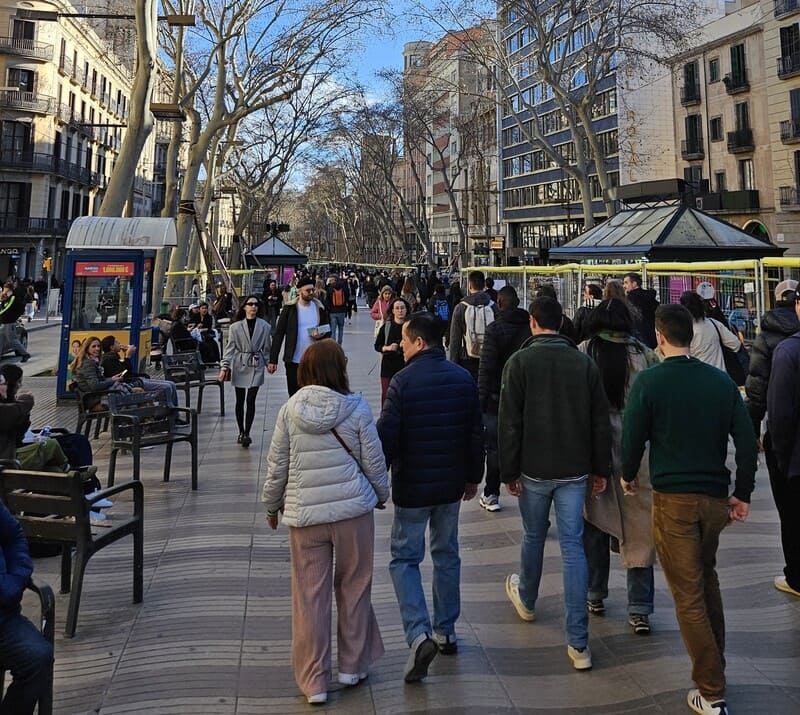
By late morning, La Rambla stops feeling like a boulevard and starts feeling like a slow-moving crowd you’re stuck inside. It’s the busiest pedestrian corridor in the city, and midday in high season is when that shows the most.
Walk it early morning or after dinner instead. The crowd thins out significantly, and it’s actually possible to look up at the architecture instead of just watching the person in front of you.
2. Most restaurants along it are overpriced and mediocre
This is one of the most consistent complaints from first-time visitors, and it’s fair. Restaurants directly on La Rambla are priced for footfall, not repeat customers, and the food quality reflects that.
Walk two streets over into Barri Gòtic or El Born instead. Same neighborhood, same walk, real prices and real food, since those restaurants depend on locals coming back.
3. The sidewalk is cluttered with tourist-focused terraces
This isn’t just a visitor complaint, it’s something Barcelona’s own city council has acknowledged directly. In 2026, the city introduced strict new design rules for restaurant terraces along La Rambla, aiming to clean up what officials themselves have called low-quality, tourist-focused clutter crowding the pedestrian space.
Worth knowing this one is actively being addressed right now, not a permanent feature. If you’re visiting in the next few years, the street should genuinely be improving.
4. The pavement itself is uneven and uncomfortable
Under your feet, La Rambla is a patchwork. In under a mile, the boulevard shifts through roughly seven different types of paving, much of it cracked concrete slabs laid down in the 1970s, combined with cafe seating and utility boxes that weren’t planned together.
Wear real walking shoes, not sandals. And if you can, prioritize the stretch nearest the port, which has already gone through the city’s renovation and is noticeably smoother and more open than the rest.
5. The historic kiosks are disappearing
The wooden kiosks that once sold flowers, birds, and newspapers are a real part of La Rambla’s history, but many of the newsstand-style ones have been phased out as decades-old licenses expired, replaced with generic ice cream stands and souvenir stalls.
Seek out the flower stalls specifically, still clustered near Boqueria market, the one stretch the city has committed to preserving in its original spot, in recognition of the florists who started trading there generations ago.
6. The street performers can feel staged and pushy for tips
The human statues and performers are one of La Rambla’s signature images, but the experience of walking past them, being watched for a reaction and sometimes pressured for money, isn’t for everyone.
For street life that isn’t staged for tourists, head to Gràcia’s squares instead. Locals actually sit there, no performance involved.
7. Very few locals actually walk it as a destination
La Rambla functions almost entirely as a tourist corridor at this point. It’s rare to see it used the way a local square or neighborhood street gets used, as somewhere to sit, linger, or run into someone you know.
Treat it as a route, not a destination. Walk it once, briskly, to get from one end of the old city to the other, then spend your actual time in the neighborhoods on either side.
8. The shopping is almost entirely generic souvenir chains
Fridge magnets, football jerseys, flamenco fans in bulk. None of it is particularly Barcelona-specific, and most of it is available at nearly identical prices at every kiosk along the entire length of the street.
For real shopping, go to Passeig de Gràcia for higher-end options, or a neighborhood market for something with actual local character.
9. It’s a magnet for pickpockets and street scams
This is a practical reality worth knowing rather than a dramatic warning. Any dense, slow-moving, distracted crowd attracts pickpockets, and La Rambla is exactly that kind of environment, along with street gambling setups designed to distract you while someone works your pockets.
Keep your bag zipped and worn in front of you, and treat it the way you’d treat any crowded tourist corridor anywhere in the world, with a bit more awareness than usual, not fear.
What to read next
If you’re rethinking how much time to spend on La Rambla, here’s where to go next:
18 things you should actually do in Barcelona
The full list of places and rituals worth your time, including how to walk La Rambla the right way rather than skip it entirely. Read it on the blog.
The best Barcelona neighborhoods for first-time visitors
Where to actually spend your time once you’ve crossed La Rambla off the list. Read it on the blog.