9 Places in Barcelona Where Paella Is Still Done Right
By Dorian · Updated October 6, 2026
Barcelona serves a lot of paella.
Not all of it deserves the name.
Near the big sights, plenty of pans are rushed, reheated, and priced for the view.
These are the places where the rice is still worth the wait, along with the honest catch for each one, because no restaurant is perfect.
1) 7 Portes, the 1836 classic that didn’t invent its famous rice
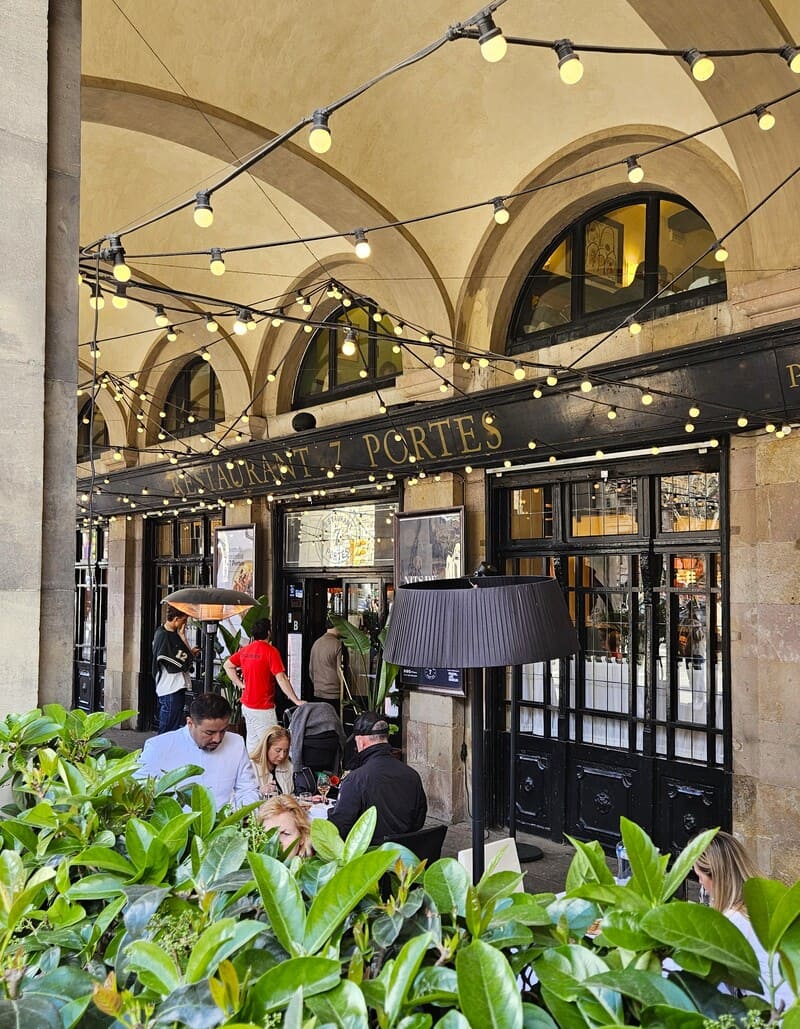
7 Portes opened as a café in 1836, under the arcades of the Porxos d’en Xifré, a short walk from El Born.
It has been a full restaurant since 1929.
Its signature dish is the arròs Parellada, a mixed paella where every shrimp is already peeled and every bone is already gone.
Here’s the twist. The dish wasn’t invented here.
It’s named after Juli Maria Parellada, a Barcelona lawyer and dandy. Around 1902, the story goes, he asked the Café Suís for a rice with no shells and no bones, so he wouldn’t have to use his fingers.
Then in 1942, a restaurateur named Paco Parellada took over 7 Portes.
No relation. Just a very lucky coincidence.
Before you sit down, look at the benches. Small plaques mark where famous diners once sat, including Lorca and Dalí.
The waiters still wear white jackets, and you’ll often hear a piano playing.
For dessert, try the pijama: flan, fruit in syrup, ice cream and whipped cream on one plate. It was a huge hit in the 1980s.
The honest catch: reviews are split on the seafood paella, and some diners find it overcooked. Order the Parellada. It’s what the house does best.
2) Els Pescadors, rice on Poblenou’s prettiest square
Plaça de Prim doesn’t feel like a big city at all.
Low white houses built for fishing families in the 19th century line the square. In the middle stand three enormous ombú trees, a species native to South America.
And there’s only one restaurant on the square: Els Pescadors, with the terrace all to itself.
Josep Maria Maulini and Toia Duran opened it in 1980, inside an old fishermen’s tavern. Their son Marc has run it since 2020.
There are three dining rooms. The one with the most charm is the old café-style room.
Order the fishermen’s rice. It’s the dish the restaurant is best known for.
The honest catch: this is one of the pricier tables in Poblenou. Locals treat it as a special-occasion lunch, not an everyday one.
3) Xiringuito Escribà, the beach restaurant run by a pastry family
Xiringuito Escribà opened on Bogatell beach in 1992, the year Barcelona hosted the Olympics.
The family behind it is the Escribà clan, pastry makers in Barcelona since 1906.
That’s why everyone tells you the same thing: save room for dessert.
The open kitchen lets you watch the pans go out, and the menu covers both paella and fideuà, a version made with short, thin noodles instead of rice.
The squid ink paella gets some of the best reviews, especially for its crispy bottom.
Locals book it for long Sunday lunches, so reserve ahead.
Fun fact: the family liked the formula so much that it opened a branch in Tokyo in 2018.
The honest catch: some longtime fans feel the quality has slipped over the years, and a few find the rice too salty. The desserts still win everyone back.
4) Casa Amàlia, the market restaurant that tells you where your food comes from
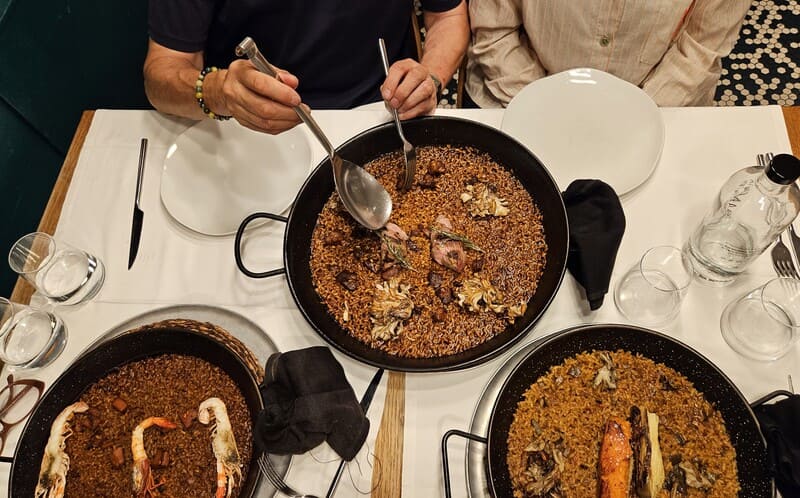
Casa Amàlia opened in 1950, right next to the Mercat de la Concepció in the Eixample.
It started out serving hot breakfasts to the people working at the market.
New owners took over in 2020, refreshed the room, and kept the market at the heart of everything.
About half of what the kitchen uses comes from the stalls next door.
Their digital menu even names which market stall supplied certain ingredients.
Over the years, regulars have included filmmaker Bigas Luna and comedian Pepe Rubianes.
The rice dishes are strong, from seafood paella to rabbit paella. Reviewers also keep mentioning the mussels in a coconut curry sauce, and the cheesecake.
Ask for the terrace. It sits on a quiet pedestrian passage beside the market.
The honest catch: it gets crowded at peak times, it isn’t cheap, and a few diners have found the paella overcooked.
5) Can Solé, a Barceloneta institution since 1903
The name over the door is older than the restaurant.
In the late 18th century, this corner of Barceloneta was home to Gregorio Solé’s shop, which sold soap, oil and household goods.
In 1903, Josep Homs bought it, turned it into a restaurant, and kept the old name.
The sky-blue walls are covered in framed photos, sketches and paintings collected over more than a century. Joan Miró and Antoni Tàpies were among its famous guests.
This is the place to try arròs caldós, a brothy rice that’s somewhere between paella and soup.
If you’d rather have it dry, the lobster paella is the other classic here.
The honest catch: there’s no sea view, and Time Out warns that extras like coffee add up fast on the bill.
6) Elche, the family that brought Valencian rice to Poble-sec
Andrés Iborra and Carmen Vicente opened Elche in 1959, naming it after their hometown in the province of Alicante.
It’s often described as Barcelona’s first restaurant to specialize in paella and rice.
Being close to the Paral·lel theaters, it quickly became a favorite of performers and audiences.
The star dish is the black rice with baby squid and artichokes.
The secret is the grain. Elche uses Bayo rice from the Ebro Delta, a cross between long-grain and bomba rice that holds its texture well.
It’s an easy stop after a morning on Montjuïc.
The honest catch: one critic loved the rice but missed the crispy bottom, and found the old-school service a little tired.
7) L’Arrosseria Xàtiva, where rice is all they do
L’Arrosseria Xàtiva has spots in Gràcia, Les Corts and Sant Antoni, and the menu runs to more than 25 rice dishes.
It’s also a good place to understand an old rivalry.
Catalans love diced onion in their rice. Valencians consider that a crime.
Catalans also happily mix meat and seafood in the same pan. Most Valencians find that absurd.
Xàtiva’s cooking leans on Alicante and Valencian traditions, including a classic Valencian paella with chicken and rabbit.
Two practical bonuses: it’s one of the most celiac-friendly rice restaurants in the city, and it offers individual paellas on weekdays, when most places require two people.
Families like it too. Kids get coloring pages and crayons.
The honest catch: a few diners find some dishes salty, and waits can stretch when it’s full.
8) La Mar Salada and Can Ros, two classics, one family
These two Barceloneta restaurants sit a short walk apart, and they belong to the same family.
Can Ros has been cooking for more than a century and is now in its fifth generation.
Its boldest dish is rice with capipota (calf’s head and foot) and prawns. Its seafood fideuà is a safer bet.
A nice bonus: the set lunch menu lets you order rice for one.
Then the family opened a second restaurant, La Mar Salada.
Most restaurants in the neighborhood close on Mondays. So Ramon Cid decided Can Ros would close on Tuesdays instead, which meant one of the family’s restaurants would always be open and full.
Today, La Mar Salada is run by his granddaughter Marta Cid, with chef Marc Singla, a former El Bulli cook, and pastry chef Albert Enrich.
Time Out names it its top paella in Barcelona.
The honest catch: both fill up fast. And the desserts are so good that Time Out suggests ordering less rice.
9) Martínez, paella with the best view in the city
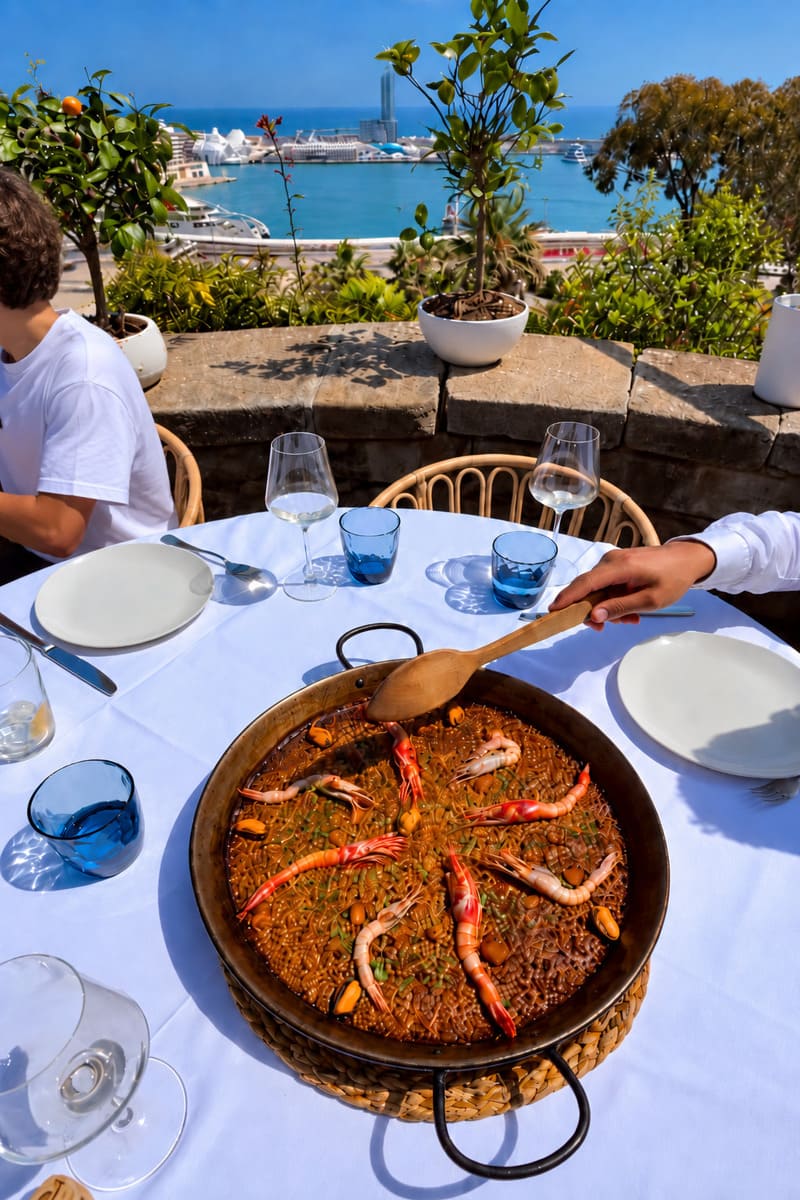
Martínez started in 2013 as a simple bar on the slopes of Montjuïc.
Within ten years, it had become a glass-walled restaurant serving 400 diners a day.
Its terrace covers about 3,200 square feet (300 m²) and looks straight down over the port. By day it’s pretty. At night, with the lights of the city and the harbor, it’s spectacular.
The chef, Juanba Agreda, mixes two traditions: the dry grain of Valencian paella with the rich base of Catalan rice.
The house classic is a dry rice with chicken and rabbit, their take on Valencian paella.
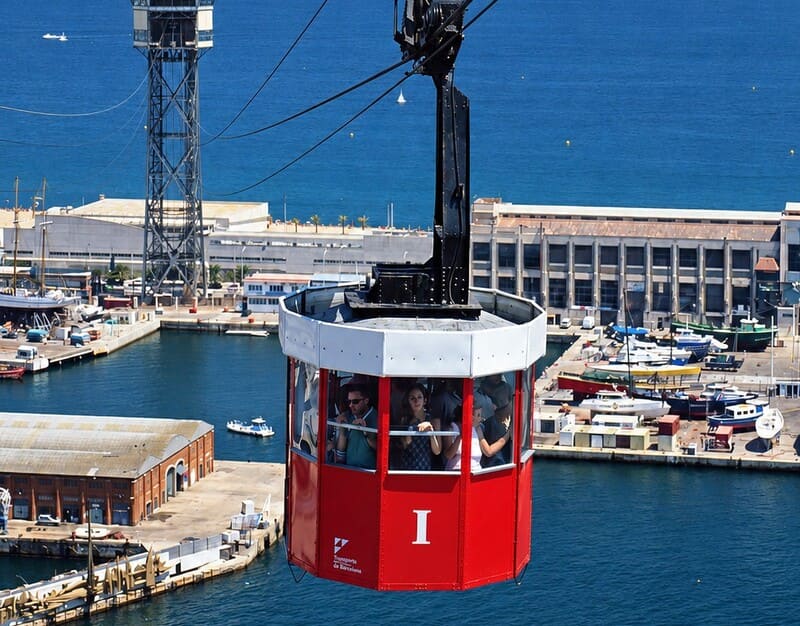
Getting there is easy. Take a taxi, or come by the Montjuïc funicular and cable car. No climbing involved.
The honest catch: you pay for the view. Some diners call the food good rather than great, but nobody complains about the view.
Before you order: what most visitors get wrong
Paella is a lunch dish. Locals eat rice at midday. Ordering it at 9pm marks you as a visitor straight away.
It’s usually made for two or more. Most restaurants require a minimum of two people, and the price on the menu is per person.
Good paella takes time. Expect to wait 20 to 30 minutes. That’s a good sign.
If your paella shows up five minutes after you order, it probably wasn’t made for you.
Scrape the bottom. The crispy, caramelized layer stuck to the pan is called socarrat. It’s the best part, not a mistake.
The original paella has no seafood. The word “paella” simply means “pan” in Valencian. The classic Valencian version uses chicken and rabbit, and in 2021 the Valencian government declared paella valenciana protected cultural heritage.
Watch for Thursdays. Many traditional restaurants in Spain put paella on the Thursday menú del dia, the fixed-price lunch menu. Nobody fully agrees on why. One popular theory is that Thursday was the traditional day off for household staff.
So order a drink, relax, and let it cook. The wait is part of the experience.
Where to go next
If Casa Amàlia caught your eye, make a morning of it. The Mercat de la Concepció next door is one of my favorite markets in the city, and it’s just one of the stops in my guide to Barcelona’s historic food markets beyond La Boqueria. Browse the stalls, then sit down to lunch with ingredients from those same stalls.
And if you’re still planning your days, you can build paella straight into them. Lunch at 7 Portes fits perfectly after a morning in El Born, and Xàtiva is right in Gràcia for the last afternoon of my 3-day Barcelona itinerary.