9 Historic Local Food Markets You Must See Beyond La Boqueria
By Dorian · Updated September 23, 2026
Everyone goes to La Boqueria. I get it.
But if you want to see how Barcelona actually shops, and some of the city’s most surprising buildings along the way, you have to leave La Rambla. Think iron halls from the 1880s, a priest’s old vegetable garden, and a roof made of 300,000 ceramic tiles.
1) Mercat de Sant Antoni, built by the man who lost the Eixample
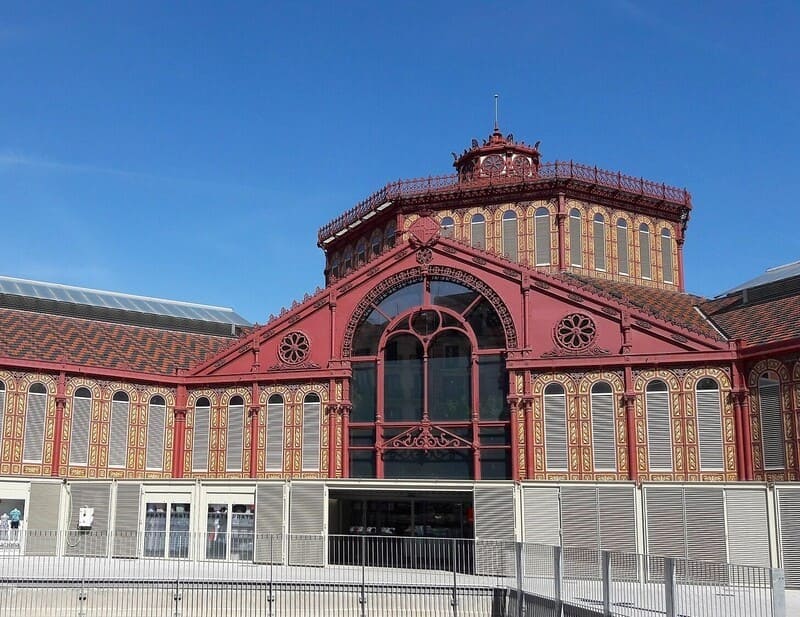
This one is huge. It fills an entire city block, laid out in the shape of a cross, with an octagonal dome rising about 92 feet (28 meters) at the center.
Its architect, Antoni Rovira i Trias, comes with a great backstory. In 1859, he won Barcelona’s own contest to design the city’s expansion, the Eixample. Then the government in Madrid stepped in and chose Ildefons Cerdà’s plan instead.
Rovira didn’t get his neighborhood. But he did get to design its markets.
Sant Antoni opened in 1882. It was the first market built outside the old city walls after they came down.
Don’t skip the basement. The market closed in 2009 for a full renovation, and archaeological finds kept it shut until May 2018. Today you can walk past a piece of the old city wall’s bastion on the -1 floor.
If you like old books, come on a Sunday morning. That’s when the Dominical, a market for secondhand books, magazines and collectibles, sets up around the building.
2) Mercat de Sarrià, the priest’s vegetable garden
Sarrià still feels like the village it once was. Its market has one of my favorite origin stories in the city.
In 1909, a new road, the Passeig de la Reina Elisenda, was cut through the village. It separated the parish church of Sant Vicenç from the rector’s vegetable garden.
That leftover garden plot is exactly where the market went up.
It opened on December 23, 1911, just in time for Christmas shopping. Three days later, the stalls were auctioned off, and vendors from the old open-air market on the square got first pick.
Look up at the main facade. The 22 rectangular stained-glass windows near the top are what fill the hall with natural light.
The market sits right across from the church, so it fits perfectly into a walk through Sarrià’s old streets.
3) Mercat de Santa Caterina, the roof made to be seen from above
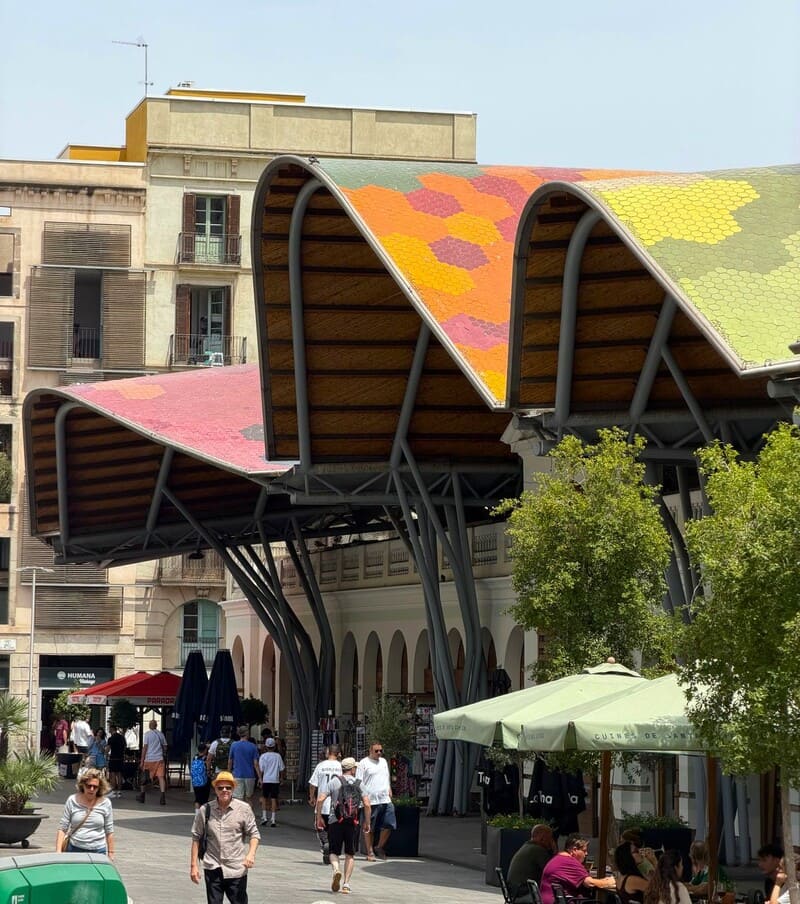
This was Barcelona’s first covered market. Its iron roof was inaugurated in 1848, on land where a convent had stood until it was destroyed in 1835.
That convent’s church, completed in 1268, was the first Gothic church in the city. Its remains turned up during the market’s modern renovation, and the discovery pushed the reopening from 2001 all the way to 2005.
Some of those remains are preserved inside, at the back of the market.
Then there’s the roof. Architects Enric Miralles and Benedetta Tagliabue covered the market with a wave of more than 300,000 colored ceramic pieces, inspired by the fruit and vegetables sold underneath.
Seen from the air, it forms a giant still life. From the street, you catch it in colorful glimpses.
One more detail. A royal decree ordered that the market be named after Queen Isabel II. The people of Barcelona simply ignored it and kept calling it after the old convent.
4) Mercat de Galvany, 59 years from gift to opening day
Sant Gervasi’s market may have the most elegant interior on this list. It also took an astonishingly long time to happen.
In 1868, Josep Castelló i Galvany donated the land for a market, in memory of his mother, Maria Galvany. That’s where the name comes from.
Then the project stalled for decades. Municipal architect Pere Falqués drew up the design in 1903, but funding problems dragged the work out. The market finally opened on February 27, 1927.
Walk to the center and look up. An octagonal dome sits on four large brick arches, surrounded by colored Modernista stained glass.
Right in the middle hangs a Modernista lantern with a clock, dating from 1928.
The building still looks almost exactly as it did on opening day. At Christmas, locals set up a pessebre, a traditional Catalan nativity scene, inside the market.
5) Mercat de la Llibertat, Gràcia’s market with a Gaudí connection
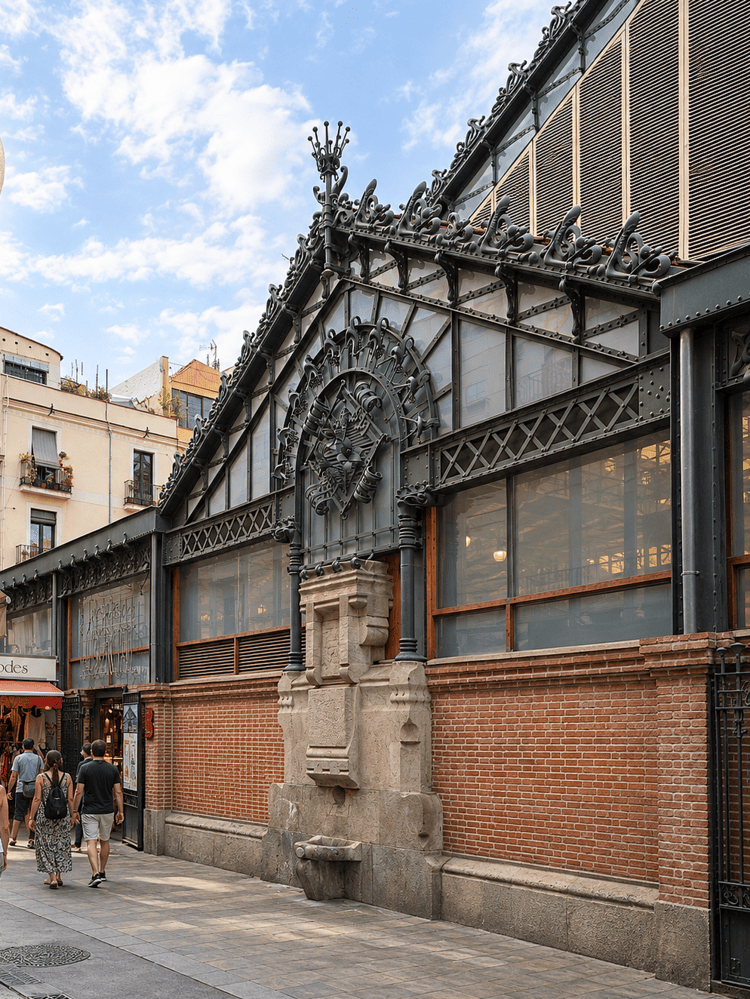
When this market was planned in 1888, Gràcia wasn’t part of Barcelona. It was an independent town, and it wanted a market to match.
The official architect was Gràcia’s municipal architect, Miquel Pasqual i Tintorer. But look closely at the wrought-iron coat of arms on the facade. It’s the work of Francesc Berenguer, Antoni Gaudí’s assistant and close friend.
The name tells a story too. The market started out as the Santa Anna Market.
Locals preferred Llibertat, meaning “liberty,” in honor of the Revolution of 1868. The people’s name won.
It opened in 1893, following the great iron market halls of its era, like Les Halles in Paris. A 2009 renovation modernized it without losing its character.
6) Mercat del Ninot, named after a tavern’s ship figurehead
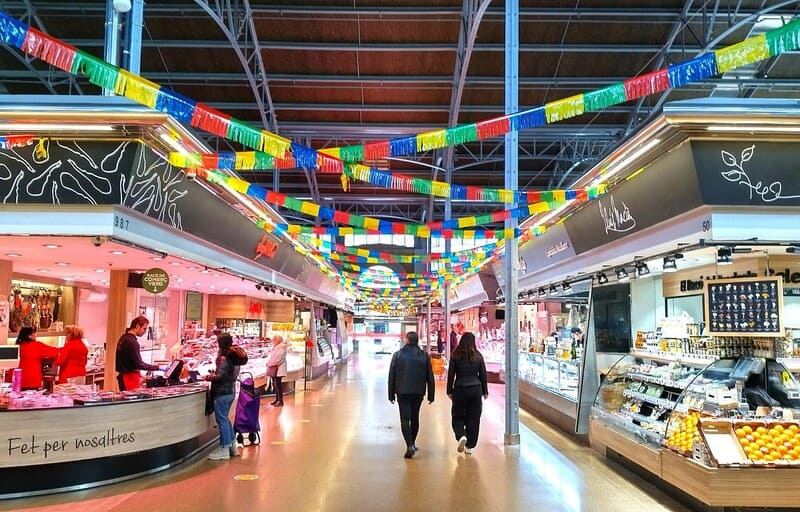
In the 19th century, this spot sat on the edge of Les Corts, then a separate town from Barcelona. Street vendors gathered here for a very practical reason.
Selling just outside the city meant avoiding the burots, the officials who taxed goods entering Barcelona.
In 1893, an open-air market was set up to organize it all. Its official name was the Mercat del Porvenir. It didn’t stick.
Instead, people named it after a nearby tavern known for its cheap wine. At the tavern’s door hung a ship’s figurehead of a cabin boy, a ninot. The original is now in Barcelona’s Maritime Museum.
The covered iron hall came in 1933, designed by Antoni de Falguera. A complete renovation by architect Josep Lluís Mateo was finished in 2015.
This is an everyday Eixample market, not a showpiece. That’s exactly why it’s worth the visit.
7) Mercat de la Concepció, next to a church that moved across town
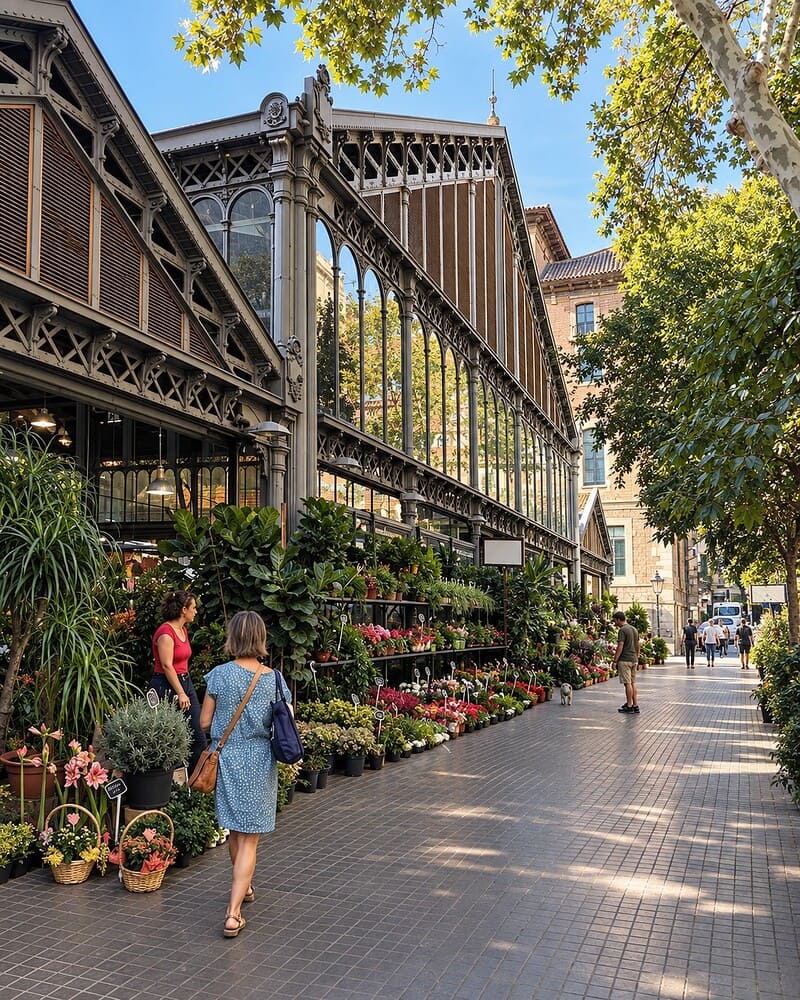
Rovira i Trias again, the architect of Sant Antoni. This market opened in 1888 in what was then the most populated part of the Eixample.
Its iron structure was built by La Maquinista Terrestre i Marítima, and the roof is covered in glazed ceramic pieces. You’ll know you’ve arrived when you see the flower stalls at the entrance.
Now step outside and look at the church next door.
The Gothic church of the Concepció didn’t start here. It belonged to the medieval convent of Jonqueres, in the old town.
When the convent was demolished, the church was taken apart and rebuilt here on Carrer d’Aragó, stone by stone. It was consecrated in its new home in 1871. The cloister followed, rebuilt smaller than the original.
The cloister entrance is on Carrer de Roger de Llúria. It’s one of the calmest spots in the whole Eixample.
8) Mercat de Sants, the “new market” that’s over a century old
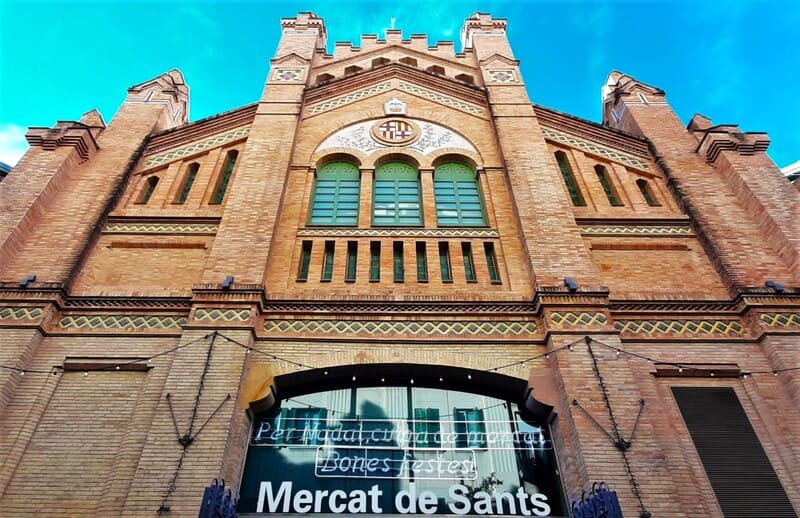
Sants was another independent town with an open-air market, first on Carrer del Sant Crist, then on today’s Plaça d’Osca.
Its covered market opened in 1913, on land known as the Hort Nou, the “new vegetable garden.” Locals started calling it the Mercat Nou, the New Market.
The nickname stuck so well that the nearby metro station still carries it.
The architect was Pere Falqués, the same man behind Galvany. You’ve probably seen his most famous work without knowing it: the ornate bench-and-lamppost combinations lining Passeig de Gràcia.
Look for the narrow windows on the facade, filled with green pottery pieces and ceramic borders. The interior was modernized in 2014, but the Modernista details of the facade were kept.
9) Mercat de l’Abaceria, Gràcia’s market is finally back
This one is both the newest and one of the oldest on the list. The Abaceria has been a Gràcia market since 1892.
It closed in July 2018 for a complete rebuild. The stalls moved into a temporary tent on Passeig de Sant Joan and stayed there for years, through delay after delay.
Construction on the new building didn’t actually start until October 2023.
The result has a signature feature: a roof of colorful ceramic tiles in red, yellow, turquoise and orange. It’s a nod to Santa Caterina’s roof, with a look all its own. Solar panels are built into it too.
Llibertat is also in Gràcia, so you can easily see both markets in one morning.
Where to go next
If Santa Caterina’s roof won you over, stay in the area. The market sits right on the edge of El Born, one of my favorite corners of the old town, and I’ve put together everything worth seeing there in the best things to do in El Born.