22 Quirky and Unusual Places in Barcelona That Tourists Often Miss
By Dorian · Updated September 21, 2026
Most visitors follow the same route around Barcelona.
I’d rather send you to the odd things sitting right beside it.
A dragon holding an umbrella. A sidewalk tile that ended up in a New York museum. A café inside a medieval bathhouse.
Start with the ones you can spot on La Rambla.
1) The Miró mosaic you have probably walked over on La Rambla
One of Joan Miró’s most important public works in Barcelona is set into the ground.
It’s on La Rambla, in Pla de l’Os, close to La Boqueria market.
It was inaugurated in 1976.
Miró was born a short walk from here.
He insisted that people be allowed to walk on it.
So they do, by the thousands, every day.
The tiles wear down and have to be replaced from time to time.
It’s one of three gifts he promised the city.
The airport mural welcomes people arriving by air.
This mosaic welcomes people arriving by sea.
The sculpture Dona i Ocell welcomes people arriving by land.
Next time you’re on La Rambla, look down.
2) The dragon holding an umbrella on La Rambla
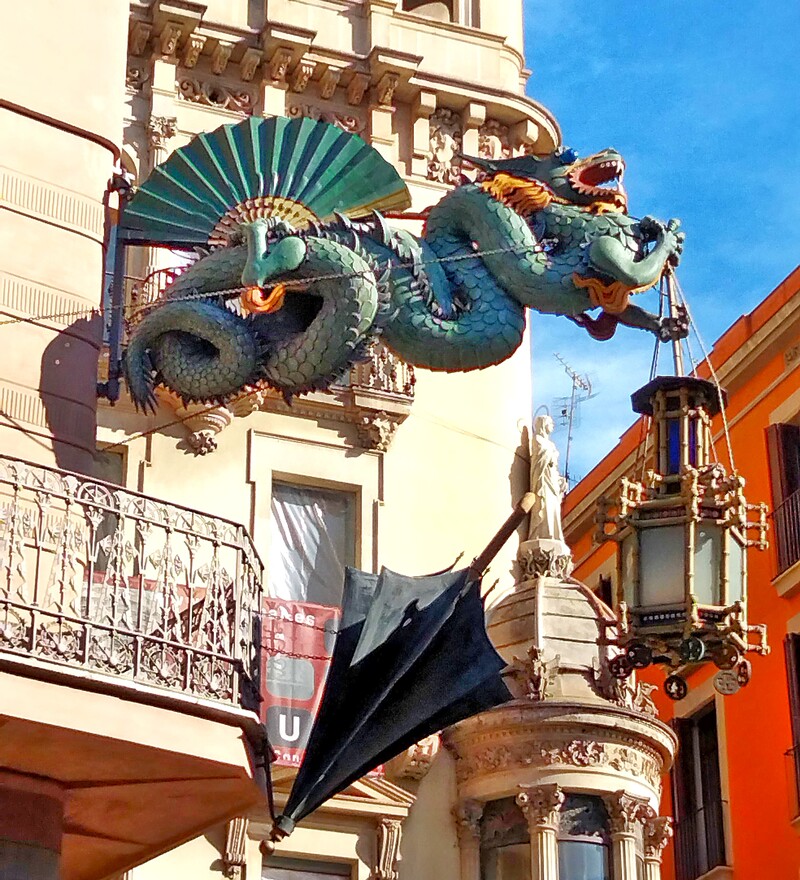
Look up at La Rambla 82.
A Chinese-style dragon leans out from the corner of the building.
It holds a lantern, and an umbrella hangs beneath it.
That’s not random. The building was an umbrella shop.
Architect Josep Vilaseca remodeled it in 1883.
The umbrellas and fans on the façade worked as advertising.
Vilaseca also designed the Arc de Triomf.
Locals call the building Casa dels Paraigües, the House of Umbrellas.
Keep looking up and you’ll see Egyptian-style decoration on the top-floor gallery.
The interior isn’t open to visitors, so enjoy it from across the street.
3) The secret skull of Pont del Bisbe
Pont del Bisbe looks medieval.
It isn’t. A disciple of Gaudí, Joan Rubió i Bellver, built it in 1928.
It links the Palau de la Generalitat with the Casa dels Canonges, across Carrer del Bisbe.
It’s one of the most photographed spots in the Gothic Quarter.
Now stand underneath and look up.
You’ll spot a small skull pierced by a dagger.
Rubió i Bellver had a much bigger plan.
In 1927 he was asked to remodel the Gothic Quarter for the 1929 International Exposition.
His idea was to replace the non-Gothic buildings around the cathedral with neo-Gothic ones.
Critics hit back hard, and the plan was never approved.
The bridge is what got built.
One theory says the skull is his answer to those critics.
Nobody knows for sure.
Legends fill the gap.
One says that if the dagger is ever removed, the city will fall.
Versions disagree on the rest: some promise bad luck for anyone who stares at the skull, others promise a wish.
Treat all of it as folklore.
4) A café in a medieval bathhouse, serving sweets made by nuns
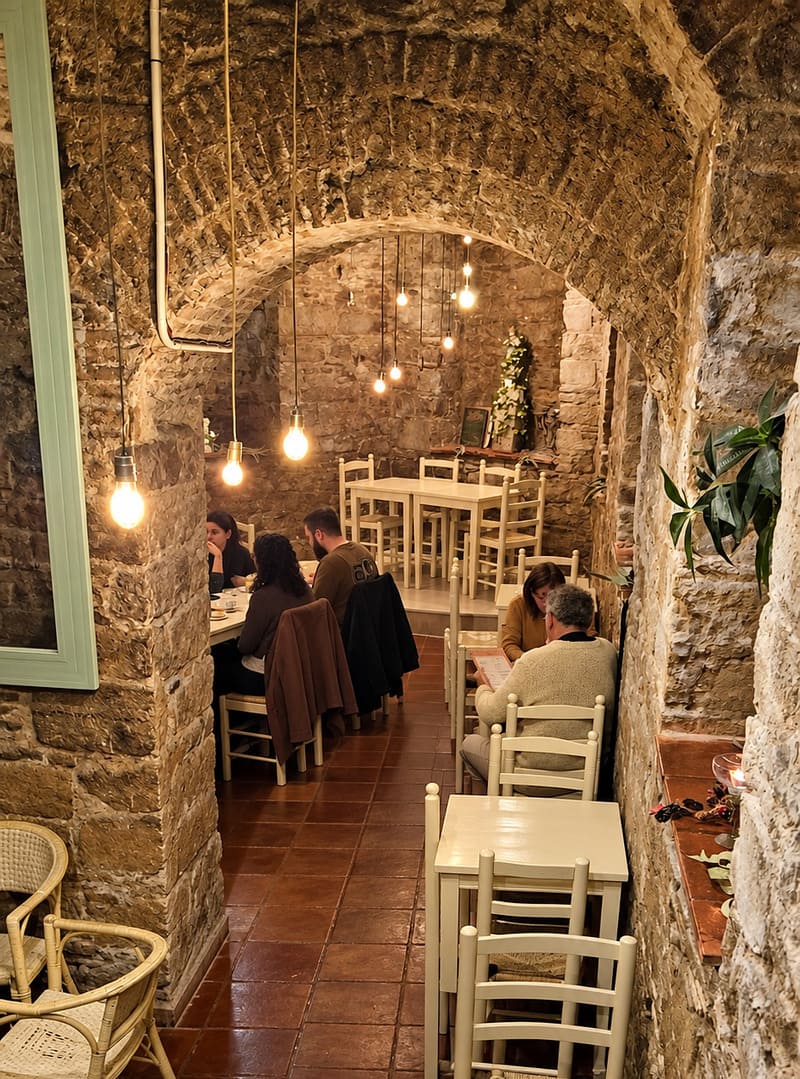
Caelum means “heaven” in Latin.
The café sells cakes, sweets and chocolate made by nuns and monks in convents and monasteries.
You’ll find it at Carrer de la Palla 8, in the old Jewish quarter.
Go downstairs.
The basement sits on the remains of medieval baths, with stone walls and vaulted ceilings.
The street around the corner is Carrer dels Banys Nous, which means “new baths street”.
The café is known for its hot chocolate.
You can also try tocino de cielo, a rich custard whose name means “bacon from heaven”.
A heads-up: the basement is reached by a steep staircase.
5) The Gaudí tile under your feet on Passeig de Gràcia
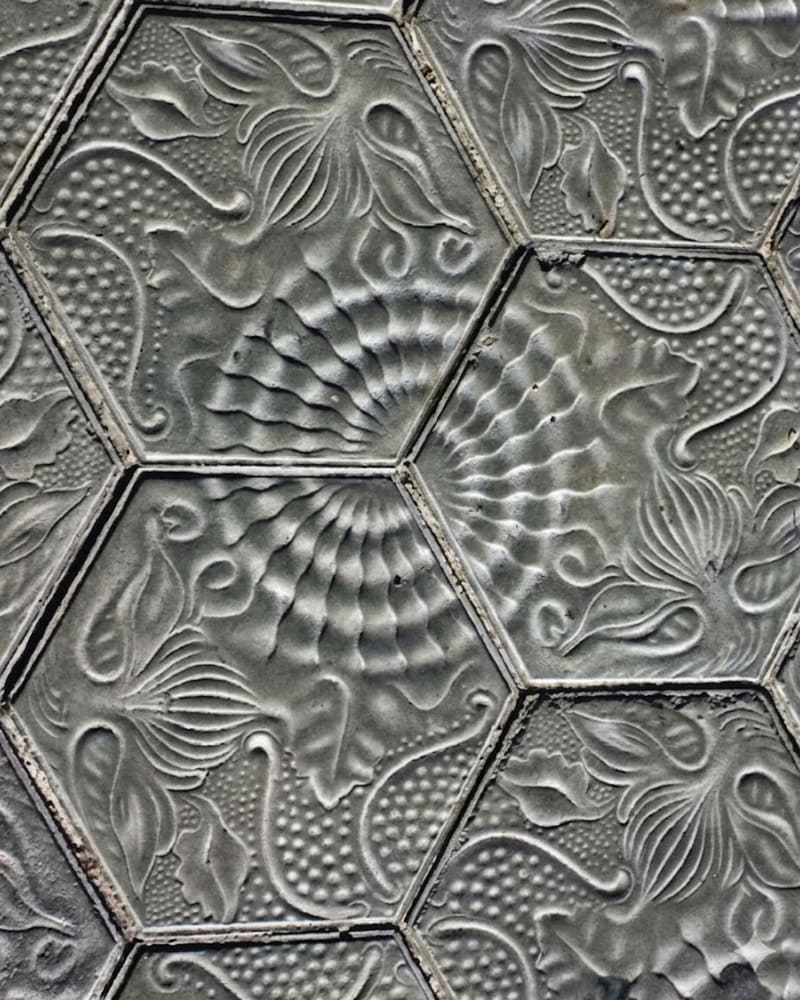
Gaudí designed the hexagonal tiles you walk on along Passeig de Gràcia.
He drew them in 1904 for the floors of Casa Batlló.
Production ran late, so they ended up in the service rooms of Casa Milà instead.
The city paved the street with a more weather-resistant version in 1997.
Look closely at the surface.
You’ll see a starfish, a snail and seaweed in shallow relief.
One tile shows only part of the picture.
It takes seven tiles to complete the design.
Some of the original tiles are in the collection of the Museum of Modern Art in New York.
Not bad for a sidewalk.
6) Roman columns inside a hiking club
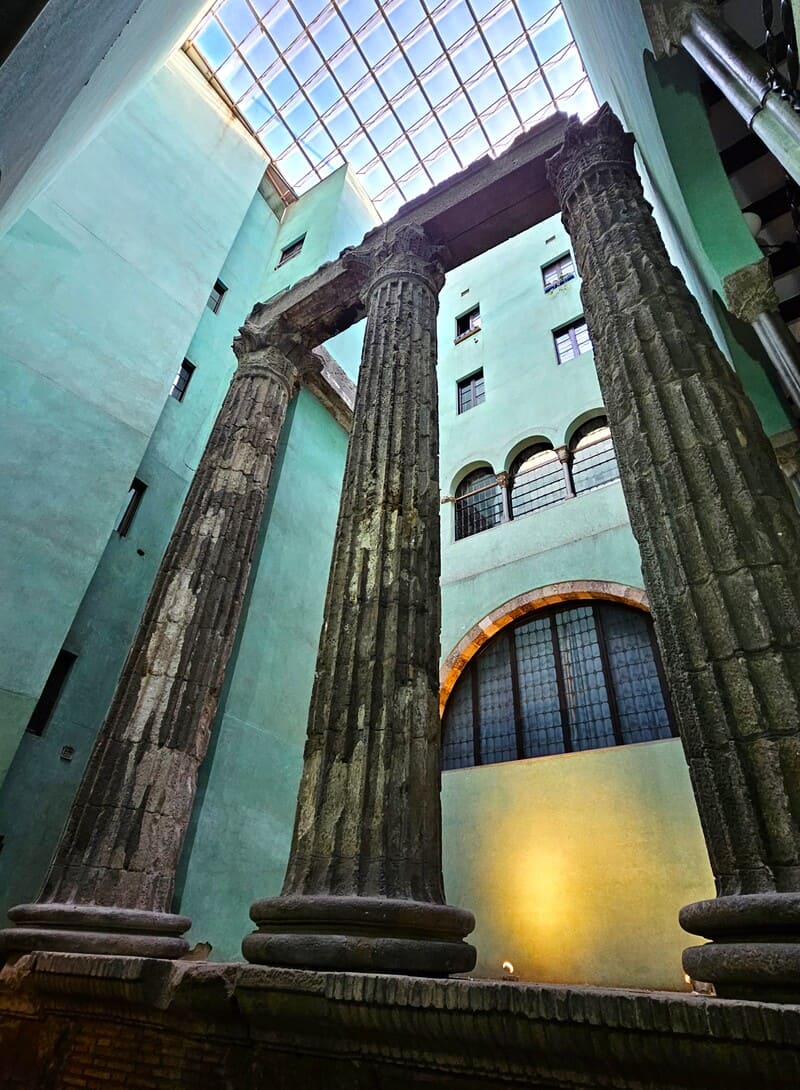
Gaudí was a member of the Centre Excursionista de Catalunya, a hiking club founded in 1876.
Its headquarters at Carrer del Paradís 10 also holds a Roman temple.
Inside a courtyard stand four Corinthian columns, each about 30 ft (9 m) tall.
They belonged to the Temple of Augustus, built in the late 1st century BC at the center of the Roman forum.
The temple stood on Mont Tàber, a hill just over 52 ft (16 m) high.
Medieval buildings grew around the columns and covered them.
They were rediscovered in the 19th century.
The fourth column stood in Plaça del Rei from 1879 until 1956, when it was returned to the courtyard.
One more thing: no inscription survives that names Augustus.
The dedication is a long-standing tradition, not proof.
7) The street where you count toothpicks
Carrer de Blai is a pedestrian street in Poble-sec, at the foot of Montjuïc.
Poble-sec means “dry village”.
The street is lined with bars serving pintxos, small Basque-style snacks held together with a toothpick.
Here’s how it works.
At many bars you keep your toothpicks on the counter or in a little jar.
When you’re ready to pay, the staff count them.
The best approach is to move from bar to bar, eating a couple of pintxos in each.
I’d skip any bar where someone waves a menu at you from the doorway.
The street gets loud and crowded later in the evening, so go early.
8) Refugi 307, the air-raid shelter neighbors dug by hand
Refugi 307 is a Spanish Civil War air-raid shelter in Poble-sec, at the foot of Montjuïc.
Neighbors dug it by hand, starting in 1937.
According to the city, Barcelona was the first city to be systematically bombed from the air.
There is evidence of almost 1,300 shelters across Barcelona.
This one was among the largest, able to hold around 2,000 people.
Its name is simply its number on the list.
Inside are almost 1,300 ft (400 m) of tunnels.
You’ll see toilets, a water fountain, an infirmary, a children’s room and a fireplace.
Posters on the walls still list the house rules.
One of them bans spreading pessimism.
The entrance is at street level, at the end of Carrer Nou de la Rambla.
You can only visit on a guided tour, so book ahead on the MUHBA website.
Plan a thoughtful stop, not a quick photo.
9) Gaudí’s earliest known public work, in Plaça Reial
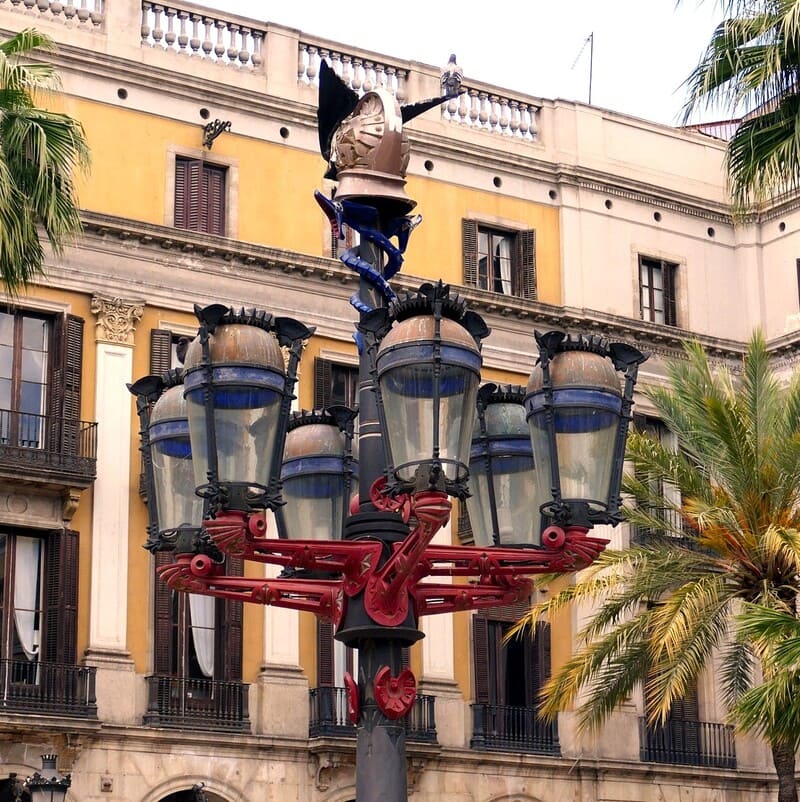
Two six-armed lampposts stand beside the fountain in Plaça Reial.
Gaudí designed them in 1879, when he was 27.
They are the earliest public work of his that we know of.
Look at the top of each one.
You’ll see a winged helmet and two snakes coiled around a staff.
Those are symbols of Mercury, the Roman god of commerce.
The city had asked Gaudí to design gas lamps for several spots.
Only five were ever built.
The other three are in Pla de Palau.
The square is full of terraces and palm trees, so it’s easy to miss what’s standing beside the fountain.
10) A galley built in a medieval shipyard
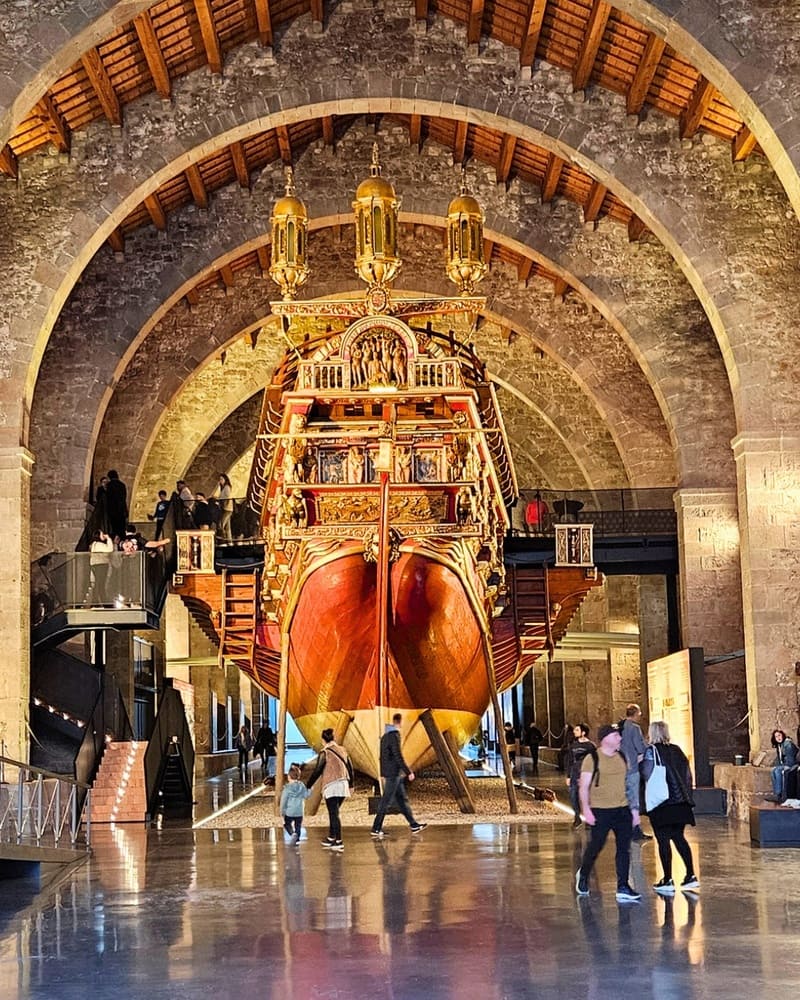
Barcelona built warships here in the Middle Ages, and the shipyard still stands.
The Drassanes Reials date to the 13th and 14th centuries.
Today the vast Gothic halls hold the Museu Marítim.
The star is a full-size replica of La Real, the flagship at the Battle of Lepanto in 1571.
The replica is nearly 200 ft (60 m) long and has 59 oars.
The original was built in this same yard in about 18 months.
The replica took about six years, from 1965 to 1971.
The museum stands at the bottom of La Rambla, near the Columbus Monument.
11) The mailbox with a tortoise on it
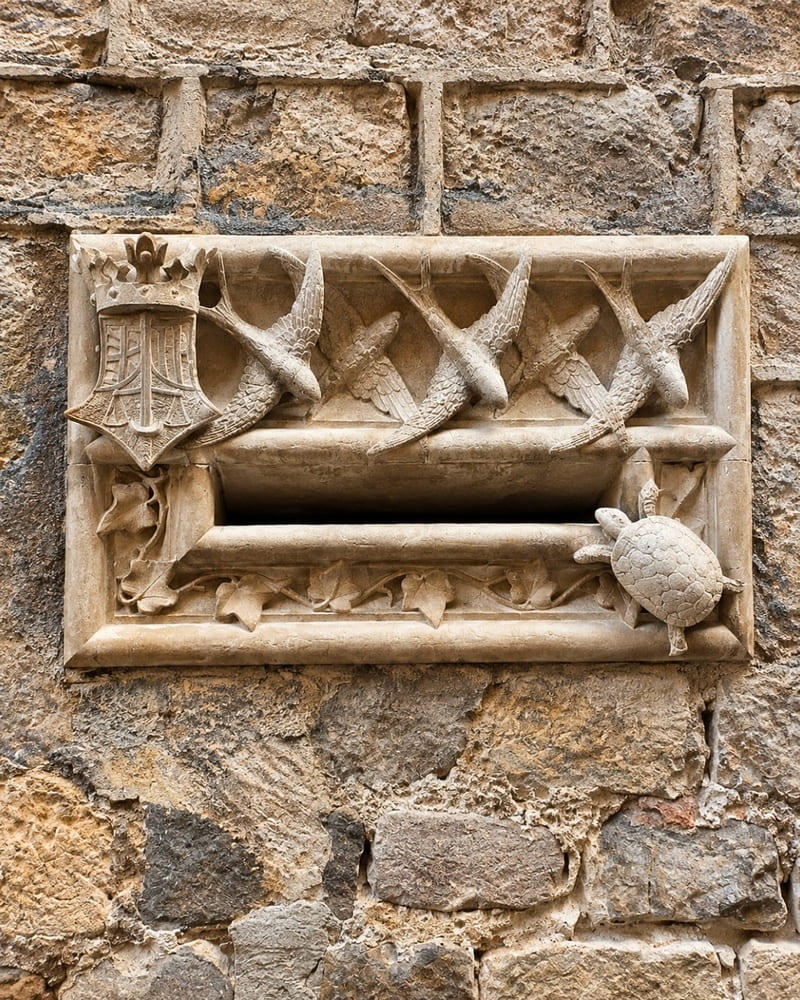
Look to the right of the entrance of Casa de l’Ardiaca, beside Barcelona Cathedral.
You’ll find a mail slot decorated with swallows and a tortoise.
Lluís Domènech i Montaner designed it, at a time when a lawyers’ association was based in the building.
The usual reading is that the swallows stand for the speed of truth and the tortoise for the slow pace of the courts.
Then step inside.
The courtyard has a fountain and a tall palm.
The building has housed the city’s historical archive since the 1920s.
Part of the wall behind it is Roman.
12) The magic shop with the wrong date on its door
El Rei de la Màgia means “The King of Magic”.
The shop is at Carrer de la Princesa 11, near El Born.
The sign on the door says 1881.
Local records point to 1878, when magician Joaquim Partagàs took over a business that already existed.
Until the 1950s, it was the only shop of its kind in Spain.
It’s often billed as the oldest magic shop in the world.
Even the window is worth a look: it’s covered in vintage magic posters.
13) A top-floor food hall with a view over Plaça de Catalunya
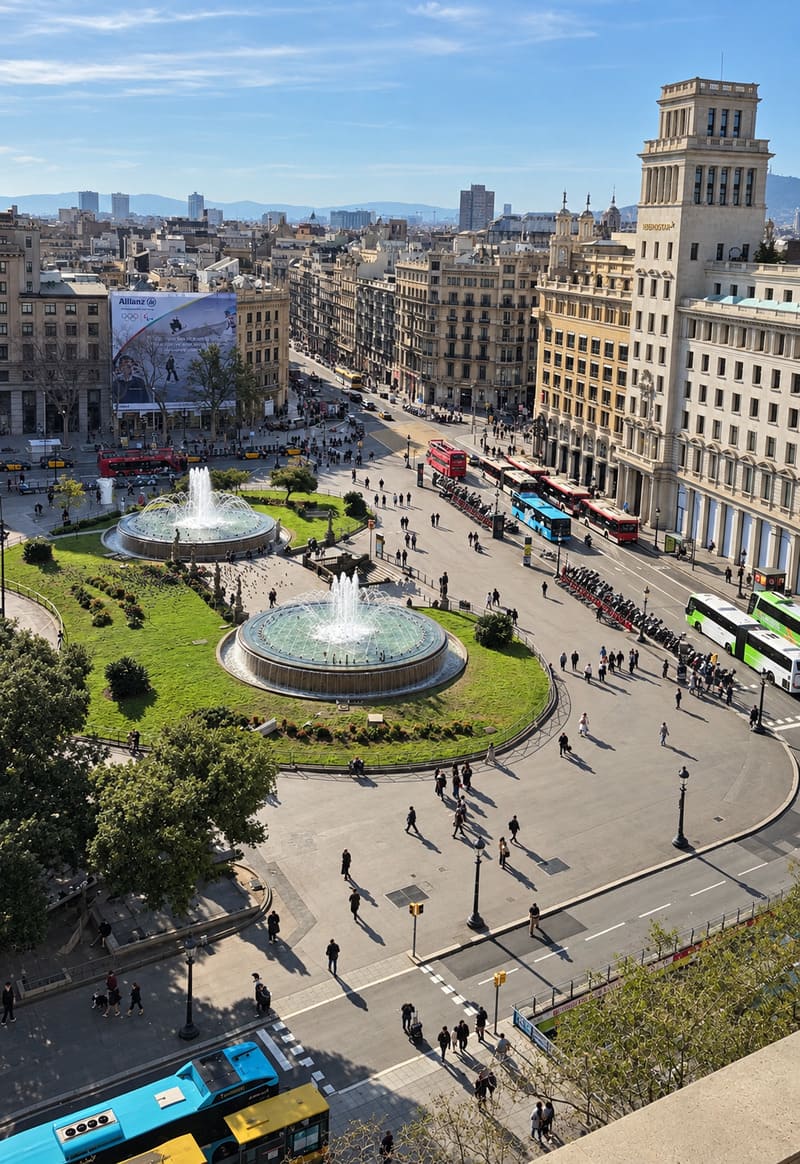
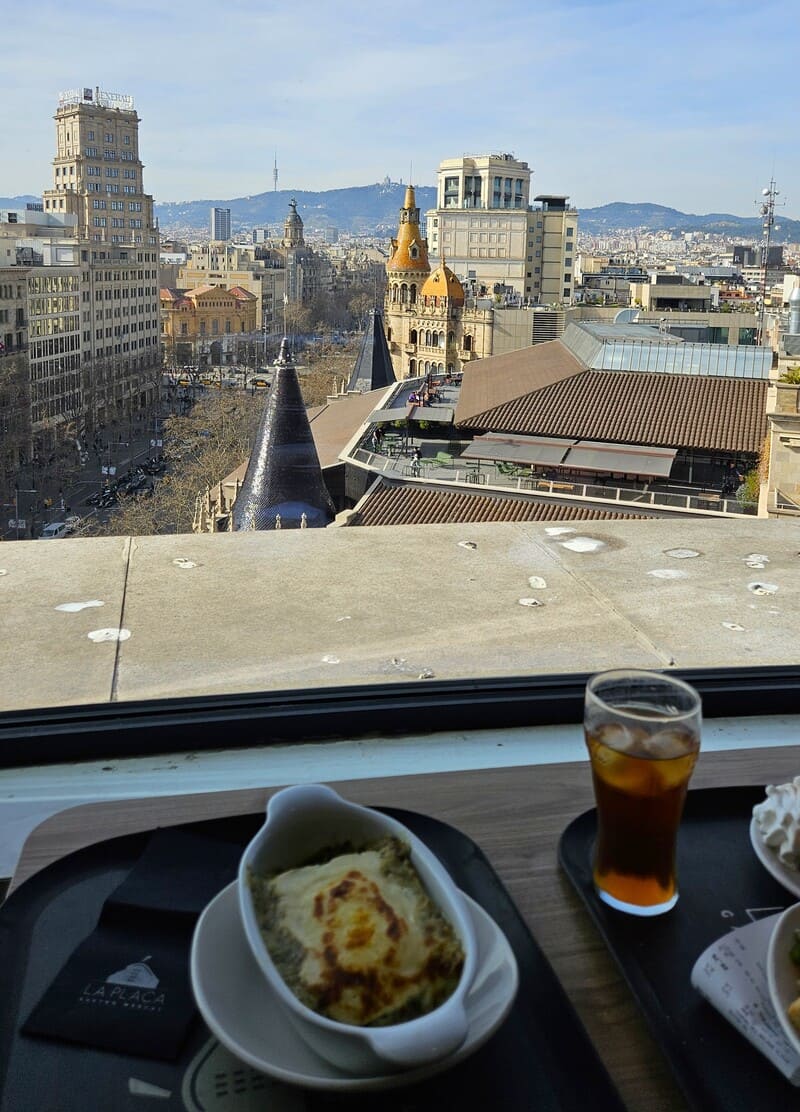
The El Corte Inglés department store sits on Plaça de Catalunya.
Ride the elevator to the top.
The 9th floor is a self-service food hall with wide views over the square and the city.
Grab a tray and pick from the different food stations.
Coffee or lunch gets you a table and the view.
It gets busy at peak meal times, so aim for a little before or after.
The store sits near the top of La Rambla, so it makes an easy pause between sights.
14) Plaça de Sant Felip Neri, a quiet square with a history
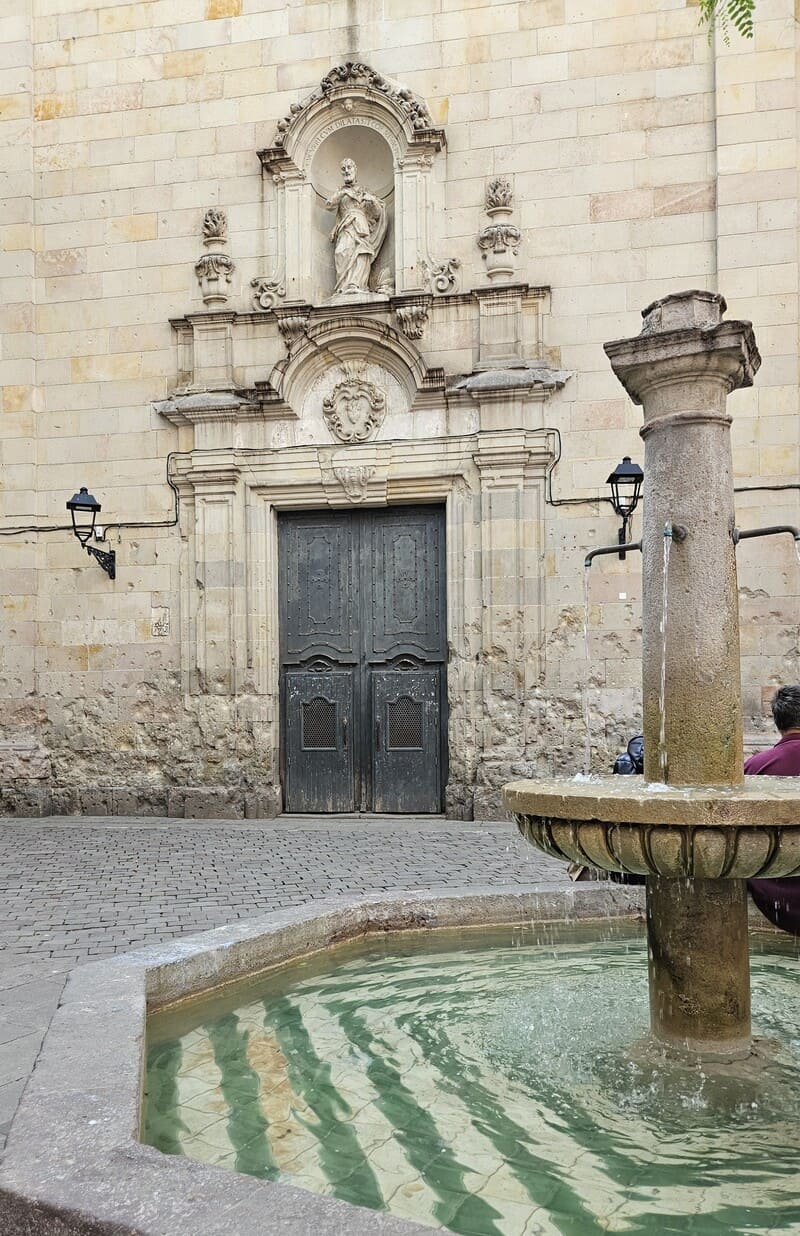
Plaça de Sant Felip Neri is a small square with a fountain and a Baroque church.
Look at the church wall.
The pockmarks come from an air raid on 30 January 1938, during the Spanish Civil War.
The raid killed 42 people, most of them children who had taken shelter in the church basement.
A memorial plaque and information signs in the square explain what happened.
You’ll find it at the end of Carrer de Montjuïc del Bisbe, close to the cathedral.
It’s a place to visit quietly.
15) A Roman cemetery you can see from the street
Around 70 Roman tombs lie in a sunken garden on Plaça de la Vila de Madrid.
They date from the 1st to the 3rd centuries AD.
A raised walkway lets you look down on them.
Romans did not bury the dead inside the city.
So this cemetery sat outside the walls, along a road.
The tombs still line up along it.
Many are cupae, tombs shaped like half a barrel.
They came to light during building work in the 1950s.
The square is close to Plaça de Catalunya, so it’s a quick detour.
16) A bar that has poured absinthe since 1820
Bar Marsella is often called the oldest bar in Barcelona.
It opened in 1820 at Carrer de Sant Pau 65, in the Raval.
The room looks the part: a marble bar, old mirrors and dusty bottles.
The house drink is absinthe, a strong anise spirit.
It’s served the traditional way, with a sugar cube and cold water.
Stories link the bar to Picasso, Hemingway and Dalí.
Treat those as local lore.
It’s an evening bar, so plan it for later in the day.
Absinthe is strong, so sip slowly.
17) A flea market under a roof made of mirrors
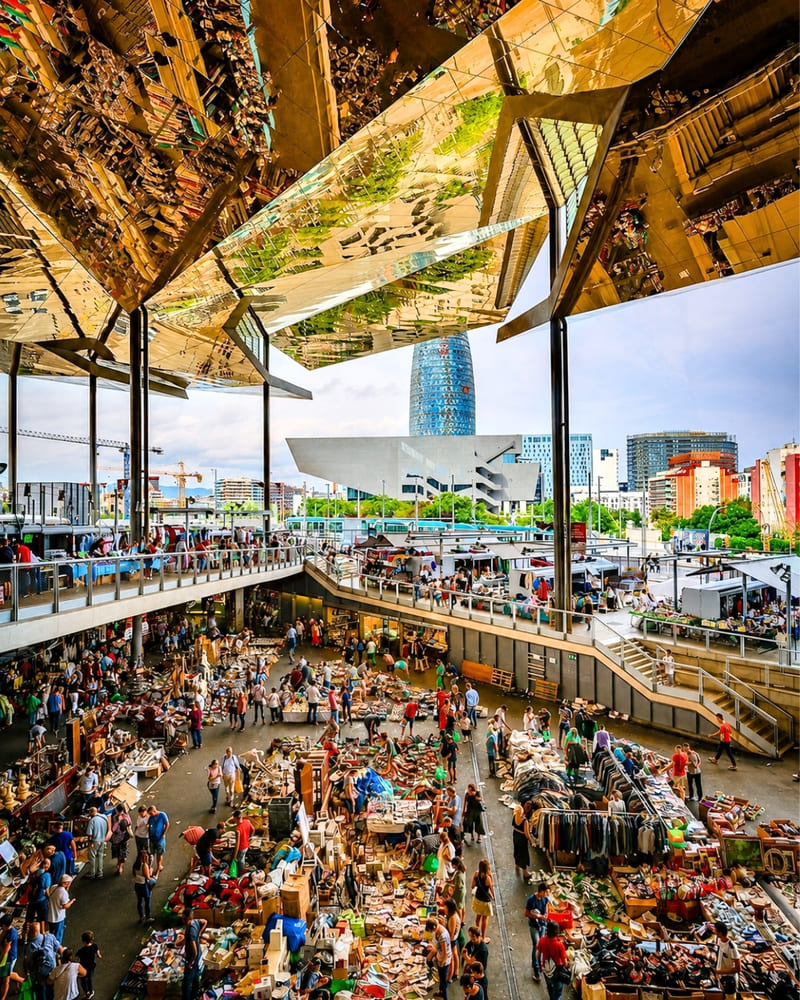
Els Encants is one of Europe’s oldest markets.
Some records place its origins in the 14th century.
Today it sits under a huge canopy with a mirrored underside.
The building opened in 2013 and covers about 160,000 sq ft (15,000 sq m).
Look up.
The mirrors reflect the stalls and the crowd below.
There are around 500 stalls, selling everything from antiques and books to records and clothes.
You’ll find it at Plaça de les Glòries.
Check the market’s website for open days before you go.
18) A cocktail bar behind a grocery shop
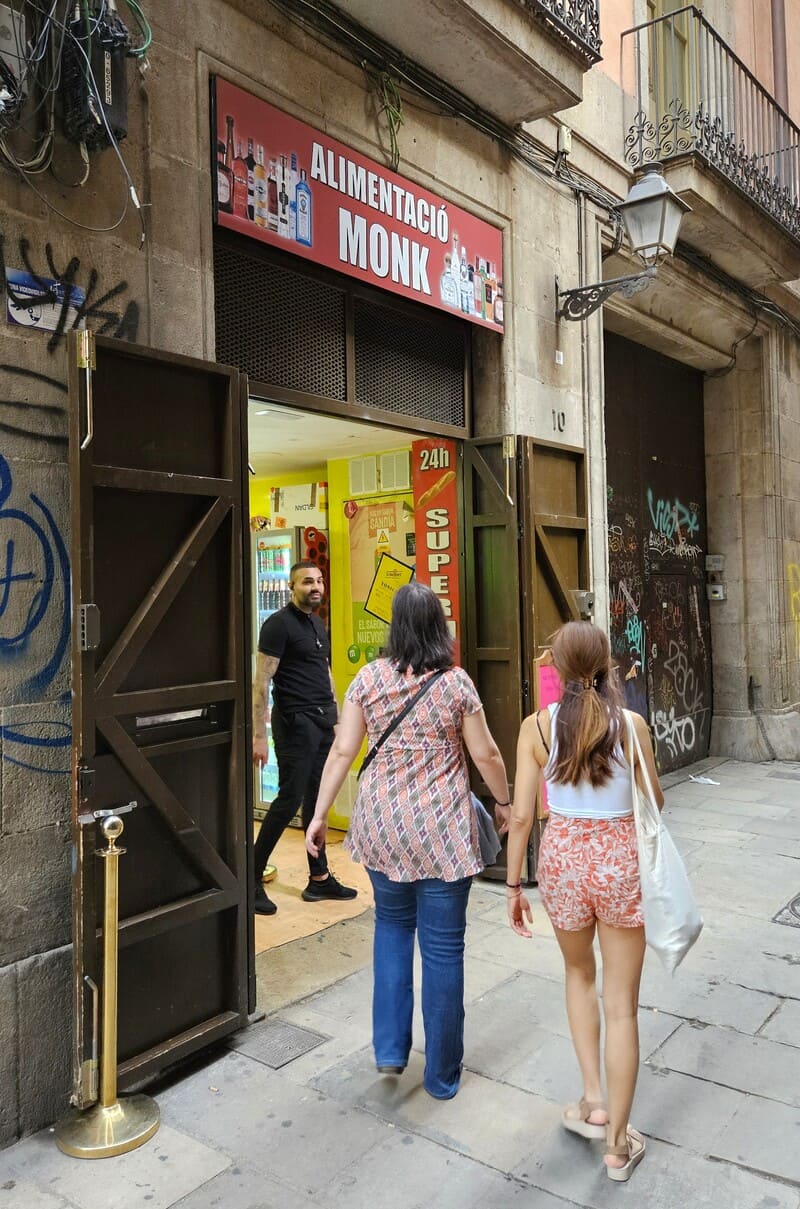
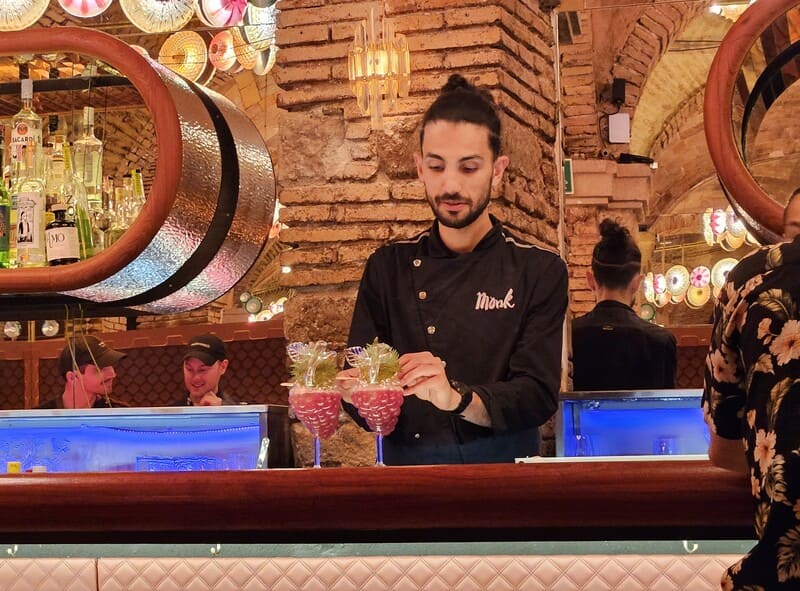
In El Born, a small shop looks like an ordinary grocery.
Walk through it and you reach a cocktail bar.
That’s Monk, at Carrer dels Abaixadors 10.
The decor is neo-Gothic, inspired by churches.
There are two spaces: a cocktail lounge and a livelier club area with a DJ.
The cocktails are inspired by artists.
The bar opens in the late afternoon, so go early if you want the calmer side.
19) A museum of working automata on top of Tibidabo
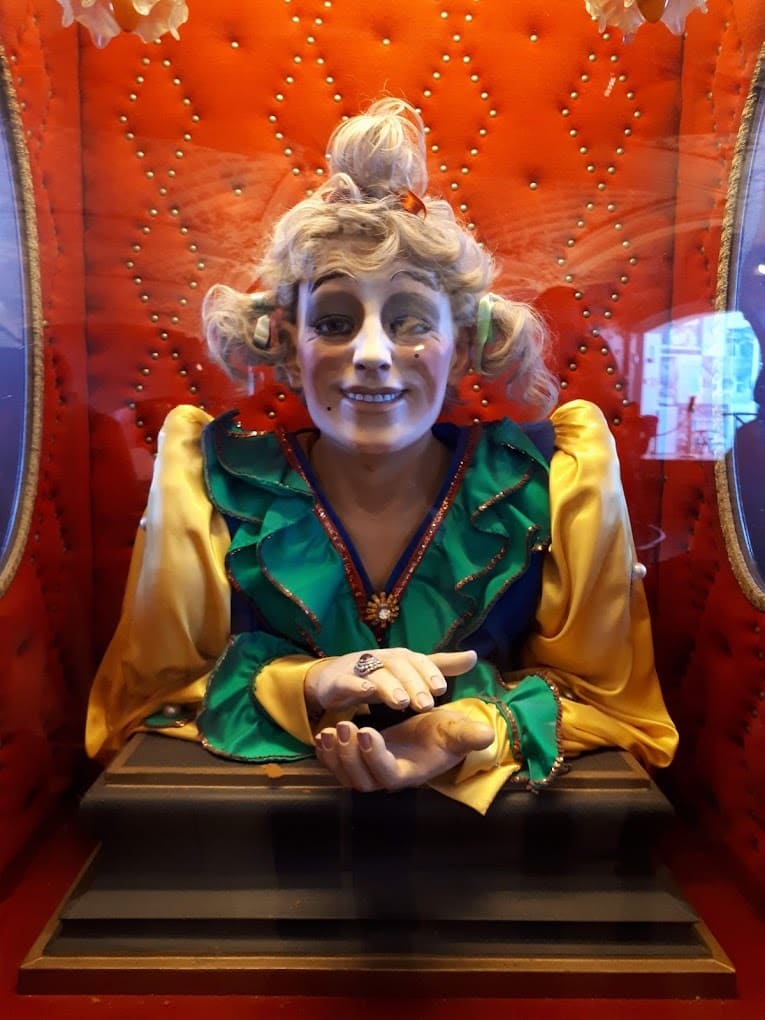
Tibidabo’s amusement park opened in 1901.
Inside it, the Museu d’Autòmats holds working automata from the late 1800s and early 1900s.
It also has coin-operated figures like the ones that once stood at fairgrounds across Europe.
One of the oldest is a mandolin-playing clown from 1880.
The story goes that Walt Disney once offered a blank check for one of the figures.
The owners said no.
The vintage Blue Tram that used to climb toward the park has been out of service for years.
Bus 196 runs up Avinguda del Tibidabo to the funicular station.
Check the park’s website for opening days before you go.
20) Gaudí’s dragon gate in Pedralbes
Gaudí’s first commission for the Güell family is guarded by a dragon.
The Pavellons Güell stand on Avinguda de Pedralbes and date from 1884 to 1887.
They once formed the entrance to the Güell family’s estate.
The star is the wrought-iron gate.
The dragon has bat-like wings and a forked tongue.
It represents the dragon that guarded the Garden of the Hesperides in the myth of Hercules.
The story comes from the poem L’Atlàntida by Jacint Verdaguer.
You can admire the gate from the street.
Visits inside depend on renovation work, so check the official site before you go.
21) The funeral carriage collection at Montjuïc Cemetery
Barcelona keeps a collection of old funeral carriages.
In Catalan it’s the Col·lecció de Carrosses Fúnebres.
The city describes it as the first and only public collection of its kind in Europe.
You’ll find it at the entrance of Montjuïc Cemetery.
It has 13 horse-drawn hearses, 6 carriages for mourning families and 3 motor cars.
These vehicles served the city for about 90 years.
Motor hearses replaced them.
The collection opened in 1970 in a basement and moved to Montjuïc in 2012.
Look for the Modernista and neo-Gothic decoration on the carriages.
Visits are guided, so check the Cementiris de Barcelona website to see how to go.
22) The maze where reaching the center is said to bring love
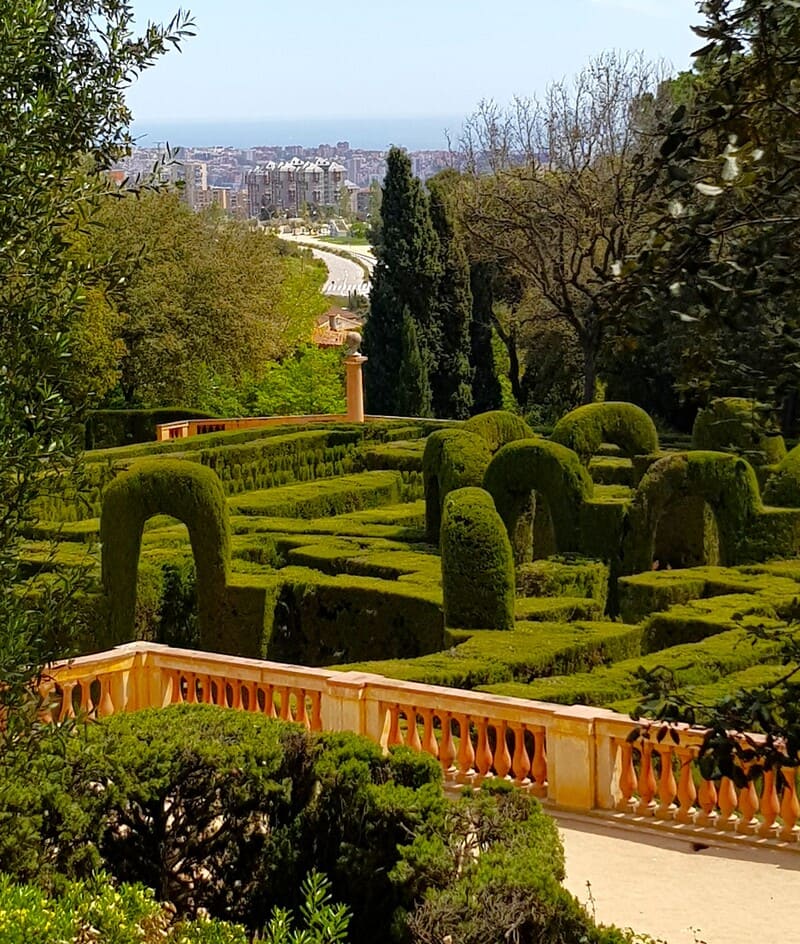
Note: the hedge maze is closed for restoration until early 2027.
Barcelona’s oldest surviving garden has a cypress maze.
The Laberint d’Horta dates to 1791.
Marquis Joan Antoni Desvalls created it with the Italian architect Domenico Bagutti.
The maze uses about 2,460 ft (750 m) of trimmed cypress hedges.
It’s inspired by the myth of Theseus.
A relief of Theseus and Ariadne marks the entrance.
Reach the center and you’ll find a statue of Eros, the god of love.
Legend says whoever gets there finds love.
The estate became a public park in the early 1970s.
Expect some steps between the terraces.
From Mundet metro station on line 3, it’s a 10 to 15 minute walk.
Where to go next
The Roman columns and the mirrored flea market both appear in my list of free things to do in Barcelona.
That list goes further: a fountain show with light and music, a cathedral cloister with 13 geese, and a medieval trading hall that opened to visitors in 2026.
If the Roman tombs on Plaça de la Vila de Madrid made you curious about what else people walk past, read my guide to the hidden corners of Barcelona next.
It covers those tombs too, along with a handful of other quiet corners most visitors never find.