Palau de la Música Catalana: My Complete Guide
By Dorian · Updated August 24, 2026
Palau de la Música Catalana is easy to walk past without realizing what’s behind the facade, a narrow street, a modest-looking entrance, and then a concert hall that feels like standing inside a greenhouse made of stained glass.
Here’s everything I’d want you to know before you go.
What Palau de la Música Catalana actually is
This building exists because of a choir.
The Orfeó Català, founded in 1891, wanted a permanent home that reflected the Catalan cultural revival happening at the time, known as the Renaixença. They commissioned Lluís Domènech i Montaner, the same architect behind Hospital de Sant Pau, and funded the entire project through public subscription, ordinary Catalans contributing alongside wealthy patrons.
Construction ran from 1905 to 1908, remarkably fast for a building this ambitious. It opened with a concert of works by Clavé and Handel, and UNESCO listed it as a World Heritage Site in 1997, jointly with Sant Pau, the only concert hall in the world to hold that status.
Getting there
The Palau sits in Sant Pere, a dense pocket of the old city, on a street too narrow to properly photograph the building from across it.
Metro Urquinaona, served by lines L1 and L4, is the closest stop, a short walk through the surrounding streets.
Tickets
Two very different ways to experience this building exist, and they’re not really substitutes for each other.
A guided daytime tour walks you through the foyer, the rehearsal hall, and the main auditorium, roughly 55 minutes, with commentary on the architecture and history. Attending an actual evening concert is the other option, and it’s worth genuinely considering, hearing the space filled with sound while the stained-glass dome glows above you is a different experience entirely from a daytime walk-through.
Pricing and exact tour times shift, so check the official site directly before booking.
The exterior facade
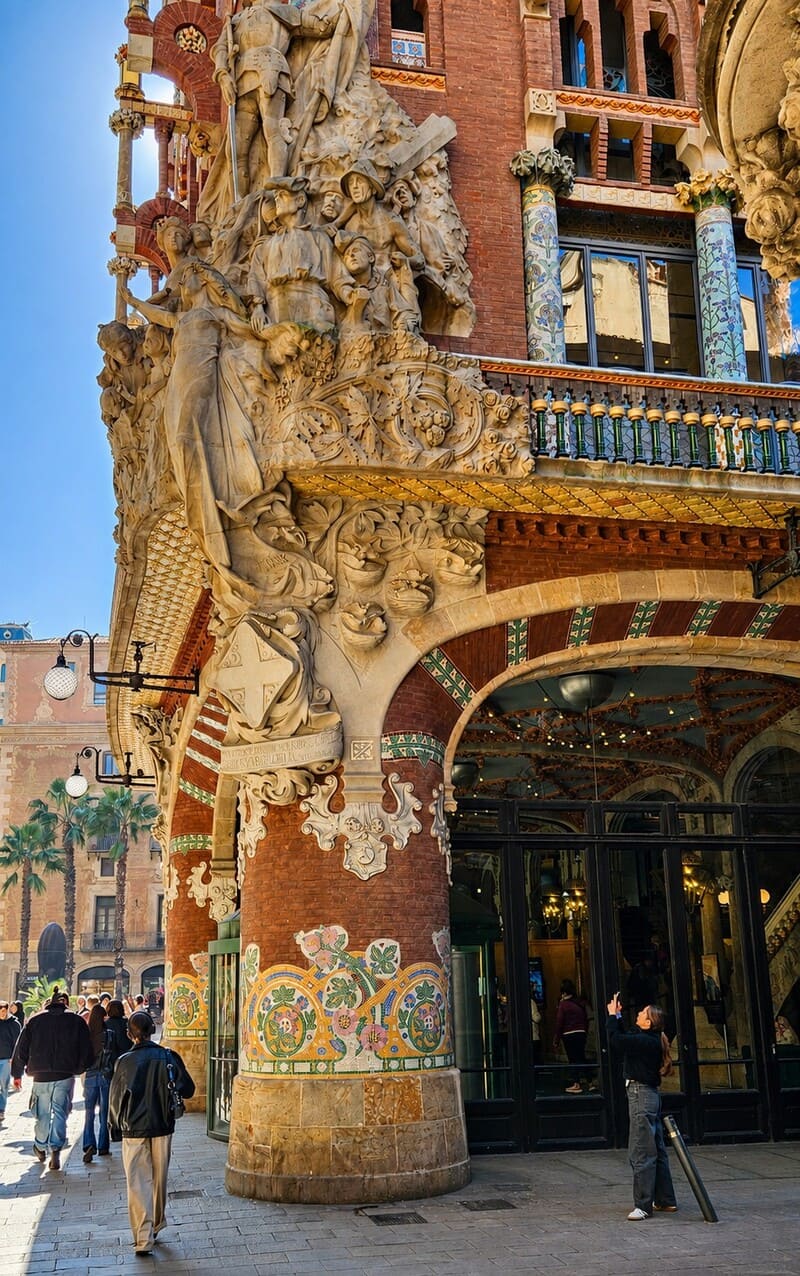
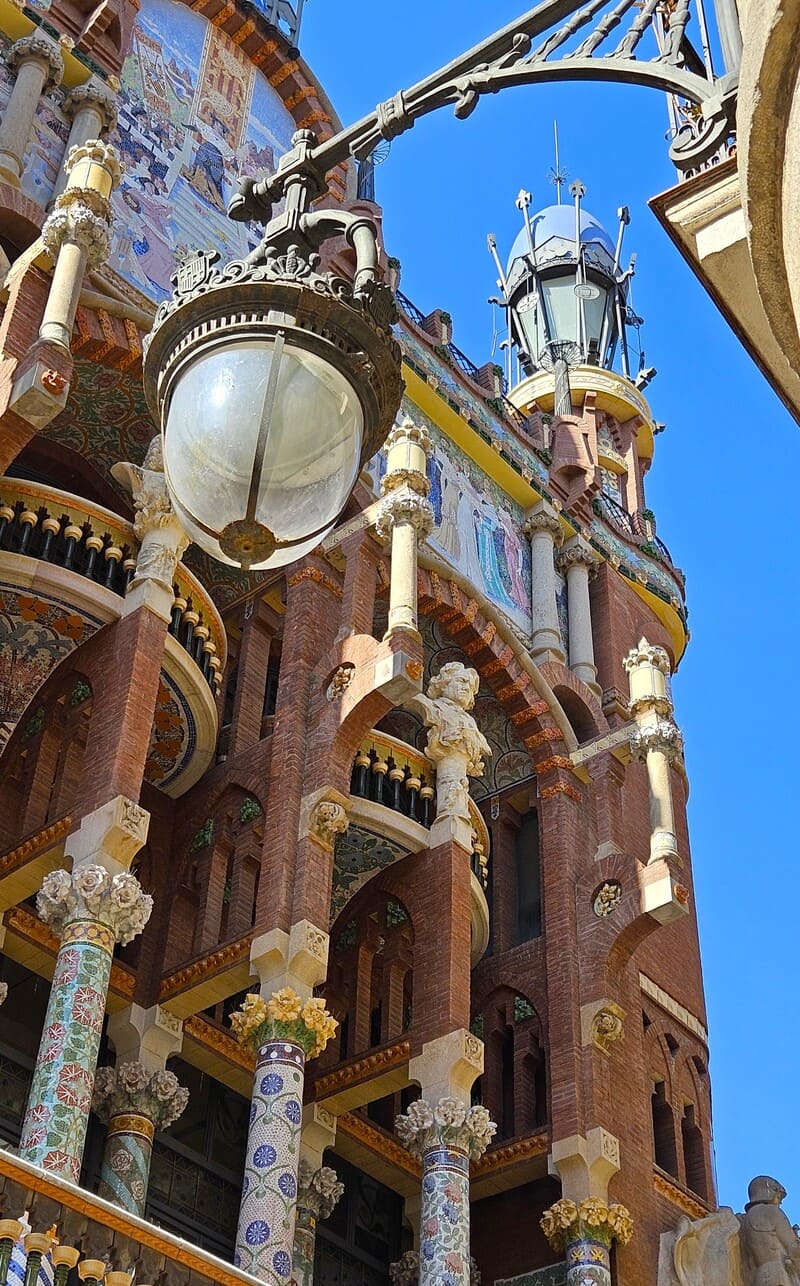
Stand at the corner of Carrer de Sant Pere Més Alt and Carrer de l’Amadeu Vives before you go in.
This is where the building’s sculptural program peaks: a sweeping stone group by Miquel Blay, shaped like the prow of a ship, showing Sant Jordi, Catalonia’s patron saint, watching over a crowd of ordinary Catalan figures, a peasant, a fisherman, a mother, children, gathered around a central muse of music. It’s meant to say the Palau belongs to everyone, not just the wealthy patrons who helped fund it.
Above, look for stone busts of Bach, Beethoven, and Palestrina, and on the building’s south side, a mosaic by Lluís Bru so high up and tucked away that most visitors never spot it at all.
The extension and the square
This original facade was the only way in until 1989, when an expansion by architects Òscar Tusquets and Carles Díaz added new service spaces and a restaurant alongside the historic building.
A second change came later. In 2002, a neighboring church was demolished to create the square you likely enter through today. That demolition revealed a stretch of stained glass on the building’s side wall that had been hidden behind the church for nearly a century, glass Domènech i Montaner had designed to eventually be seen, decades before anyone could actually see it.
The corridor of columns
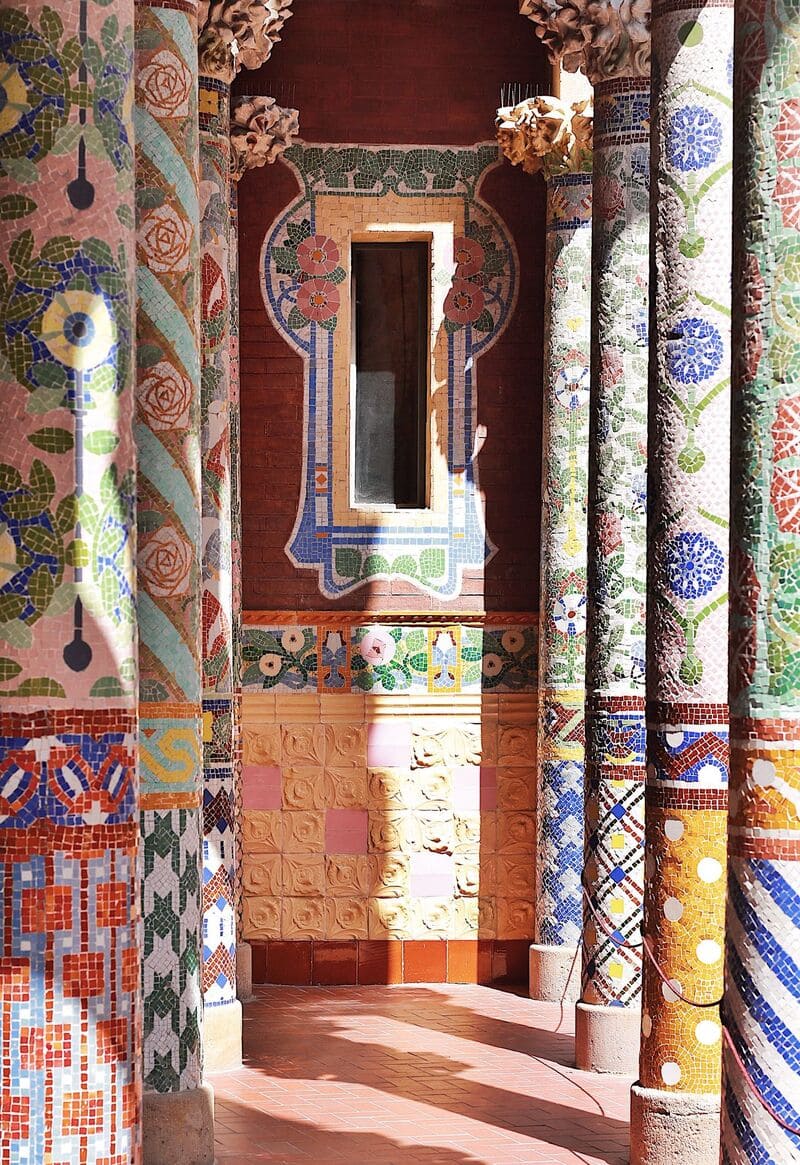
Before you reach the auditorium, you walk through a foyer and a side corridor lined with columns, and this is easy to rush past on the way to the main event.
Don’t. There are 40 columns throughout the building, each one wrapped in trencadís, and each one genuinely different from the next, roses on one, a different flower or pattern on another. Upstairs, a balcony holds 14 more, each dedicated to its own floral design. Walking this passage in good daylight, with color bouncing off every surface, is honestly one of the best parts of the visit, and it happens before you’ve even sat down.
Inside the concert hall
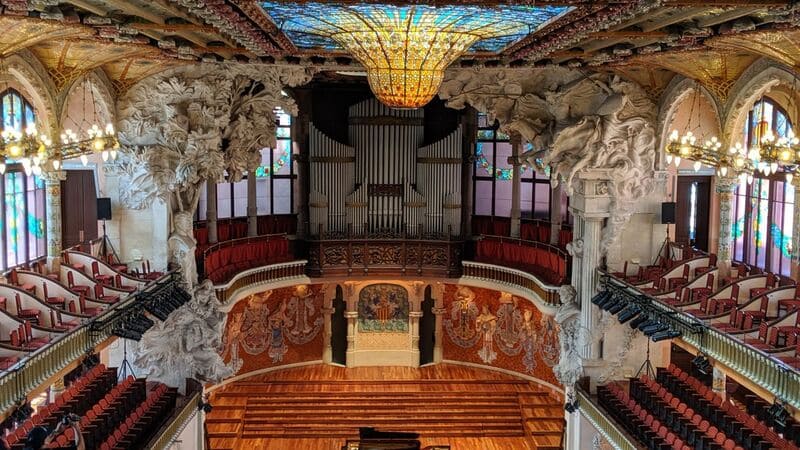
This is the part photographs never quite capture.
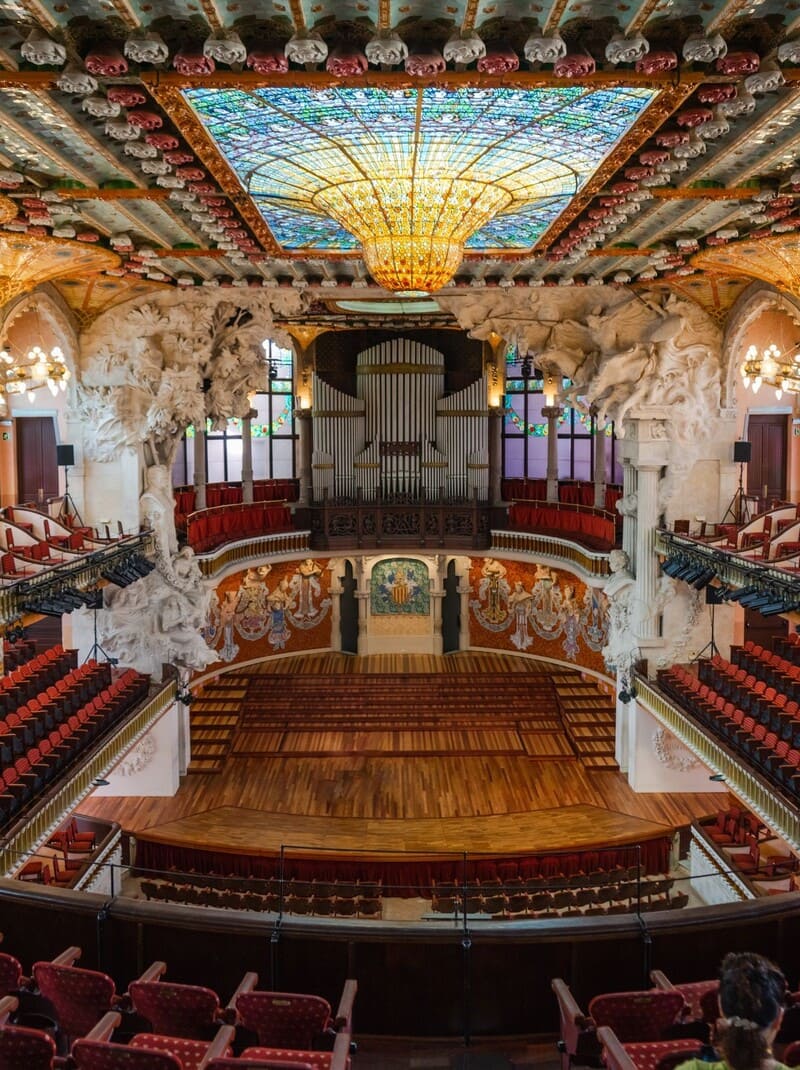
Domènech i Montaner used an innovative iron structure that let him replace load-bearing walls with glass, something structurally unusual for the time. The effect is a hall that feels lit from everywhere at once, floral mosaics climbing every column, natural light pouring through colored glass on all sides.
Above the audience, an enormous inverted stained-glass dome, designed by Antoni Rigalt, represents the sun, ringed with golden and blue tones that shift depending on the time of day.
On the stage wall behind the performers, eighteen mosaic muses, each one holding a different musical instrument, rise up in trencadís, Catalan Modernisme’s signature broken-tile technique.
A bust of Josep Anselm Clavé, a pioneer of Catalan choral music, sits on one side of the stage, Beethoven on the other, a deliberate pairing of local and international musical tradition.
Still a living building
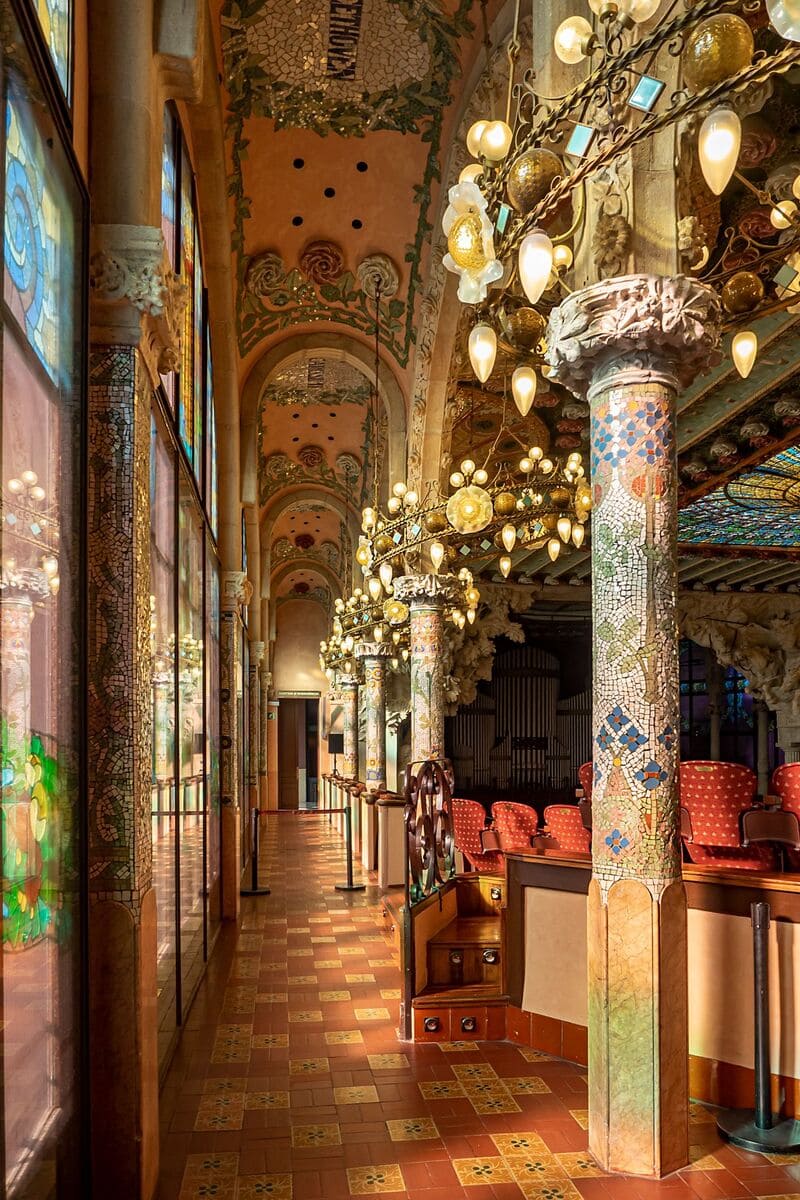
Unlike some Modernisme landmarks that have become pure museums, the Palau never stopped being what it was built for.
The Orfeó Català still rehearses and performs here, and the hall hosts several hundred concerts and events a year, everything from classical symphonies to flamenco and contemporary music. It’s one of the few UNESCO sites in the city where the building’s original purpose and its life as a visitor attraction genuinely overlap.
Practical tips
If your schedule allows it, I’d lean toward catching an actual concert over a daytime tour, the building was designed around sound and light working together, and a tour alone only shows you half of that.
If a concert doesn’t fit your trip, book the guided tour in advance rather than hoping to walk up, time slots are limited and this is a popular stop.
Where to go from here
Domènech i Montaner built one more masterpiece across the city, and it might be the most surprising building in all of Barcelona once you know its backstory: a hospital that operated for over a century and looks nothing like one. I wrote a full guide to it, and the two sites are close enough to visit on the same day: Hospital de Sant Pau: My complete guide.
And if you’re curious how the Palau fits into the wider rivalry between Barcelona’s Modernisme architects, I’d read this one next. It’s the piece that first made the case that Gaudí wasn’t working alone: Barcelona’s best Modernisme buildings (and why they’re not all Gaudí).