Hospital de Sant Pau: My Complete Guide
By Dorian · Updated August 24, 2026
Most people walk right past Hospital de Sant Pau on their way to Sagrada Família and never realize what they’re missing. It’s the largest Art Nouveau complex in the world, and it was a working hospital until surprisingly recently.
Here’s everything I’d want you to know before you go.
What Hospital de Sant Pau actually is
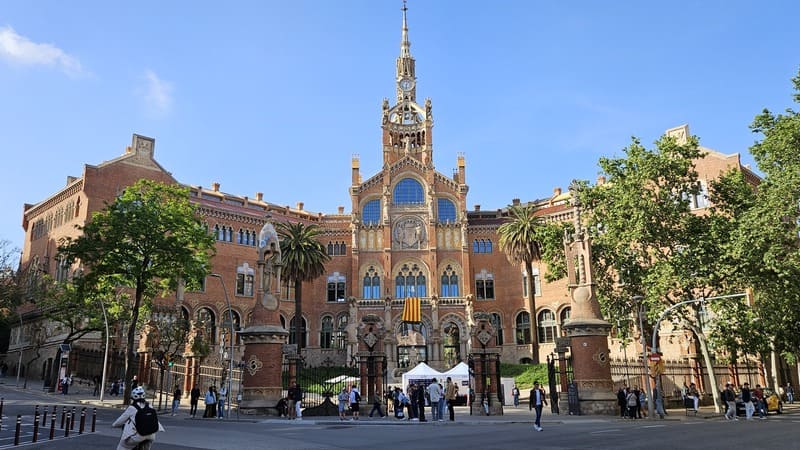
This building exists because of one man’s will.
Pau Gil, a Catalan banker living in Paris, died in 1896 and left part of his fortune to build a new hospital for Barcelona. He asked for something specific: the most advanced medical, technical, and architectural thinking available at the time.
The hospital he was replacing, Hospital de la Santa Creu, dated back to 1401. It was the oldest hospital in Spain, but by the late 1800s it had become cramped, outdated, and stuck inside the Raval, a district with no room left to expand.
Domènech i Montaner, already known for the Palau de la Música Catalana, took on the project in 1902. He studied more than 200 hospitals across Europe before drawing a single plan.
Getting there
The easiest approach, if you’re already visiting Sagrada Família, is on foot. Avinguda de Gaudí runs directly between the two, a straight, tree-lined walk of about 10 to 15 minutes.
By metro, Line 5 stops right at Hospital de Sant Pau, a short walk from the entrance.
Tickets
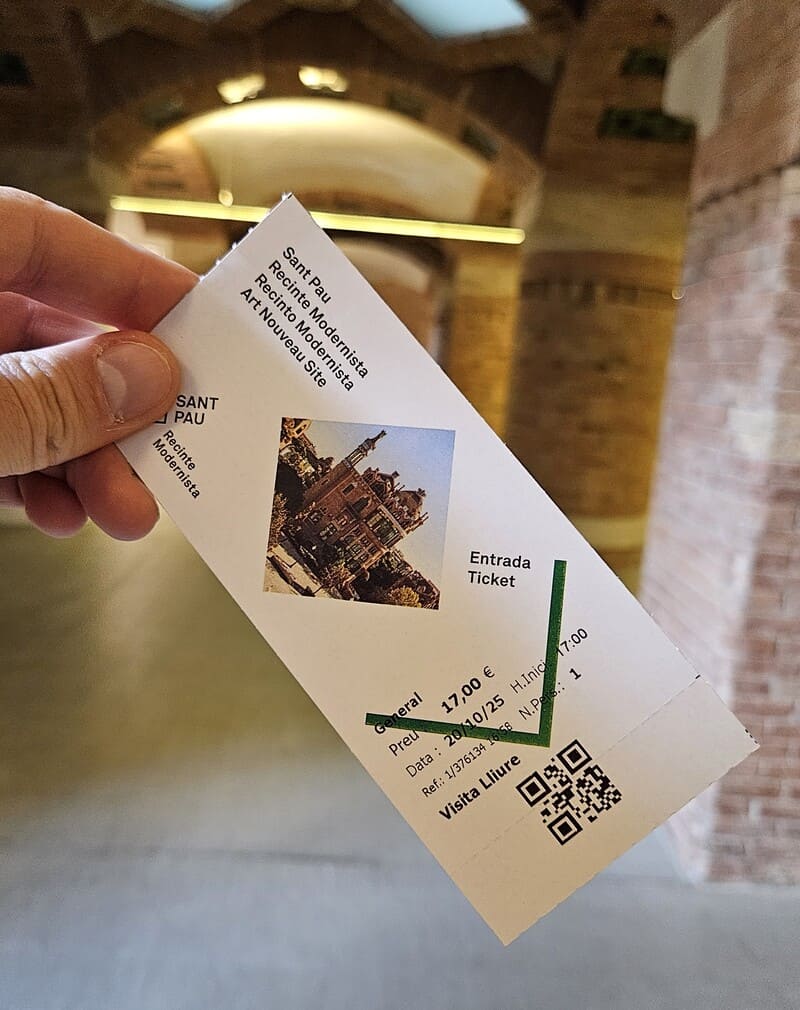
Sant Pau offers both a self-guided visit, where you’re free to wander the pavilions and gardens on your own pace, and guided tours that go deeper into the architecture and history.
Pricing and hours shift by season, so check the official site directly before you go rather than relying on a fixed number from an older post.
A hospital designed like a garden city
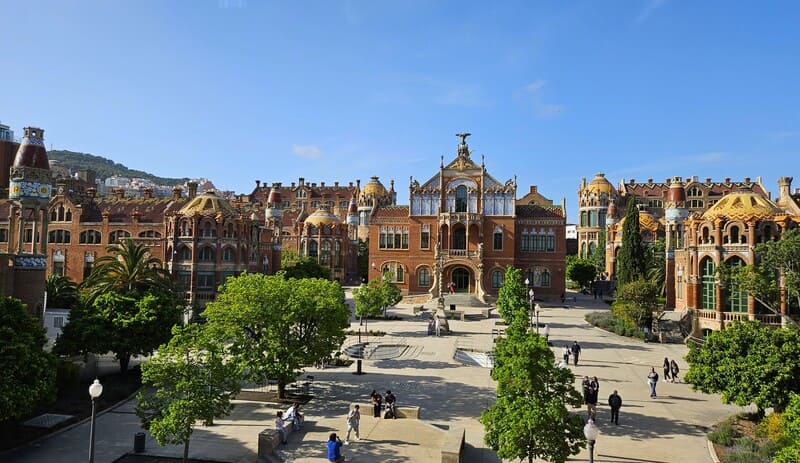
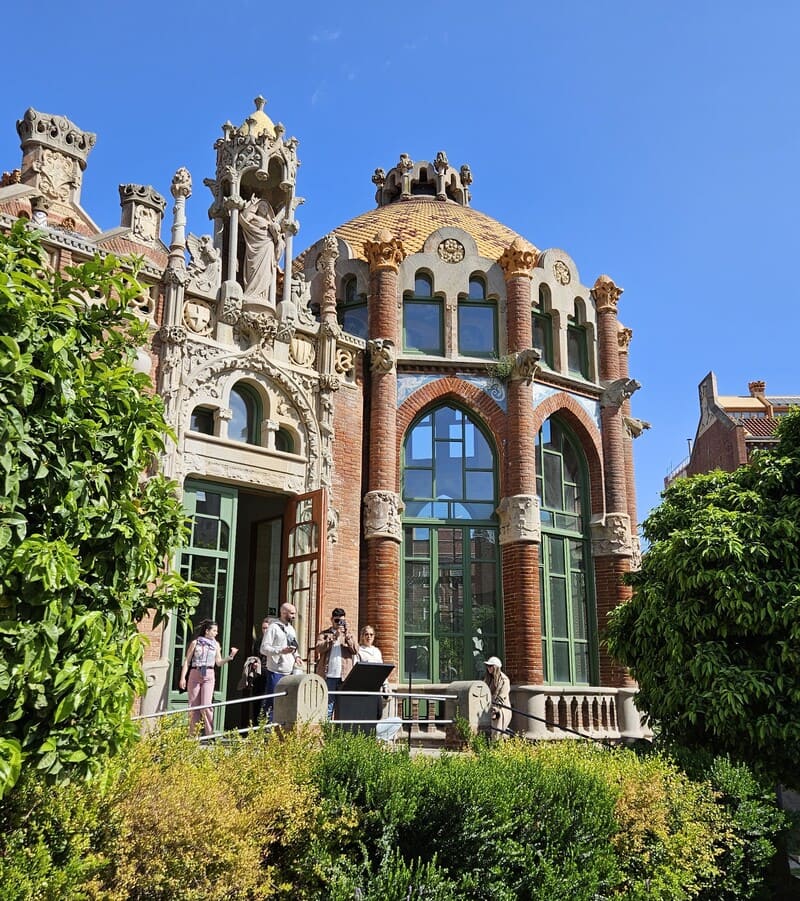
Here’s the detail that surprises people most: the entire complex sits at a 45-degree angle to the surrounding Eixample grid, deliberately rotated.
That wasn’t a design flourish. It was calculated to give every pavilion maximum sun exposure throughout the day, since natural light and ventilation were considered essential to healing at the time, not decorative extras.
Instead of one large hospital building, Domènech i Montaner split everything into small, separate pavilions, connected by more than half a mile of underground tunnels. Staff and supplies moved between buildings below ground, so the gardens above stayed quiet and uninterrupted for patients.
The idea was radical for its era: a hospital where people could walk outside, breathe real air, and not feel like they were locked inside an institution.
The Administration Pavilion
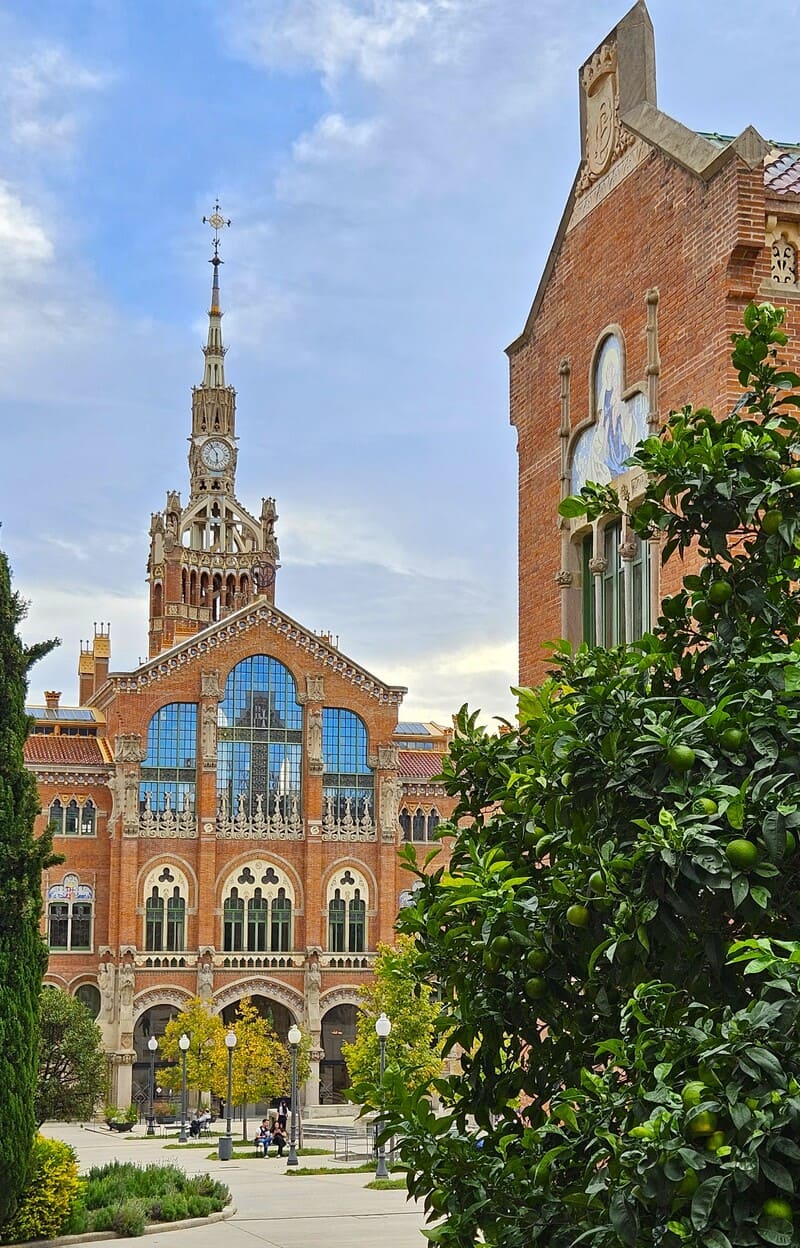
This is the building you see first, and it doesn’t look like a hospital entrance at all.
Inside, a domed ceiling covered in pink tiles rises over the lobby, with a sweeping staircase curling upward beneath it. Upstairs, the Sala Domènech i Montaner has a soaring arched ceiling, patterned tilework, and stained glass by Mario Maragliano, some of it echoing Islamic architectural influences.
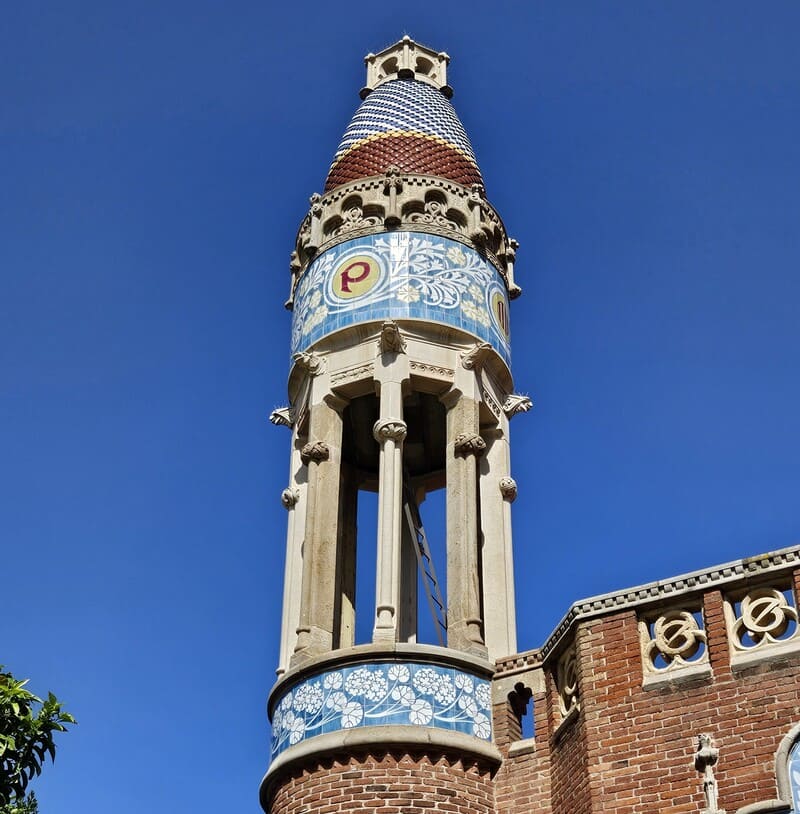
Two small Greek letters are carved into the building, alpha near where construction began and omega where it finished, marking the start and completion of the main structure.
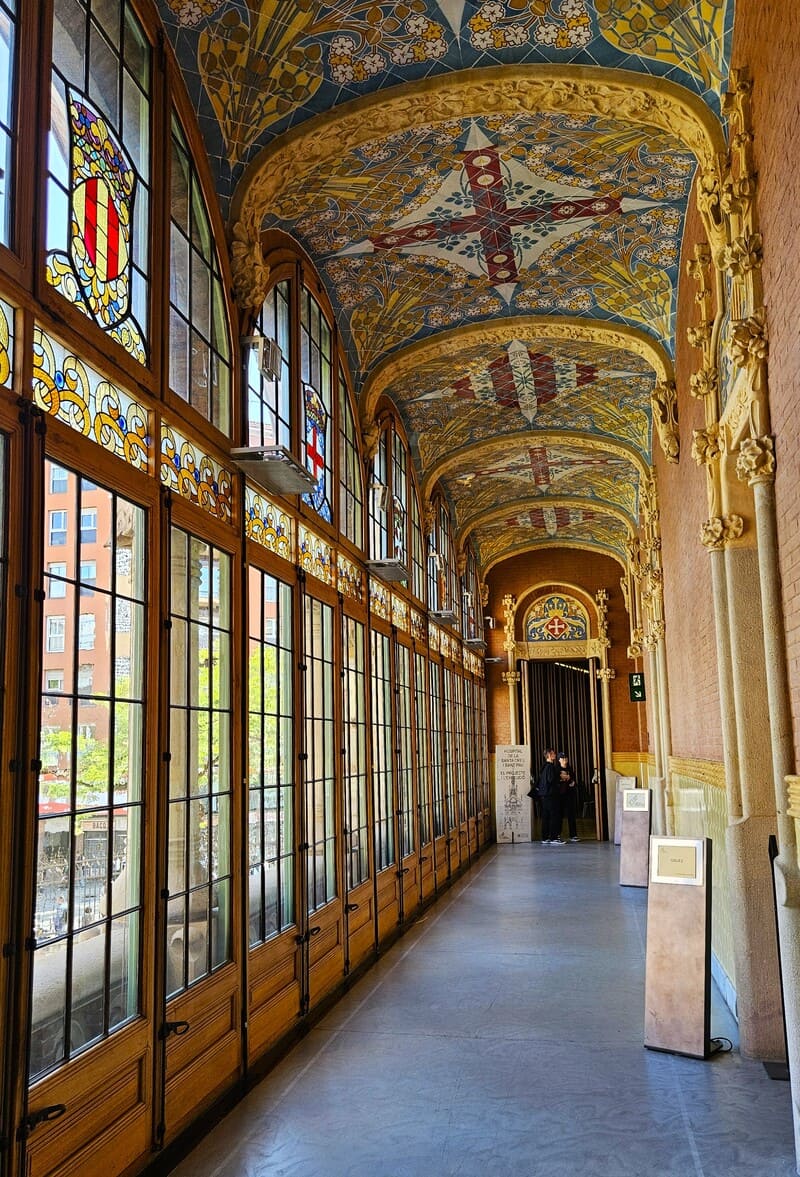
A long gallery leads off from that hall, lined with stained glass on both sides and a vaulted ceiling painted in the same pink, blue, and gold palette as the lobby below. It’s easy to walk through quickly on your way to the pavilions outside, but it’s worth slowing down here, few visitors expect a hospital corridor to look like this.
A view you won’t expect
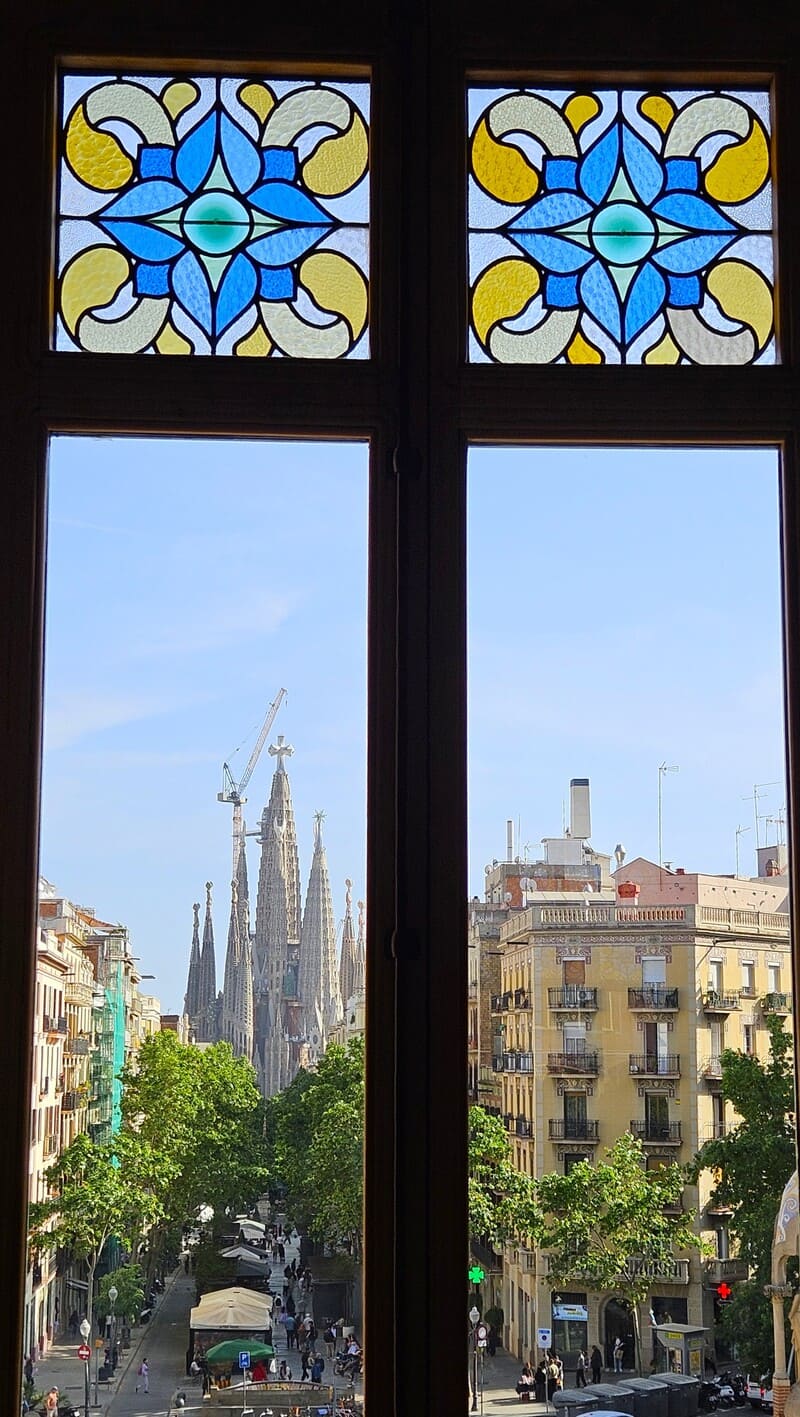
From certain windows inside the Administration Pavilion, framed by colored glass, Sagrada Família is visible in the distance across the rooftops.
It’s a small moment, but a good one, two of Domènech i Montaner and Gaudí’s generation of Barcelona architects, separated by a straight walk down one avenue, both visible from the same spot.
The pavilions and gardens
The original plan called for 48 separate pavilions. Only 27 were ever built, 16 of them in full Modernista style, and construction continued for nearly three decades, well past Domènech i Montaner’s death in 1923, finished by his son Pere Domènech i Roura.
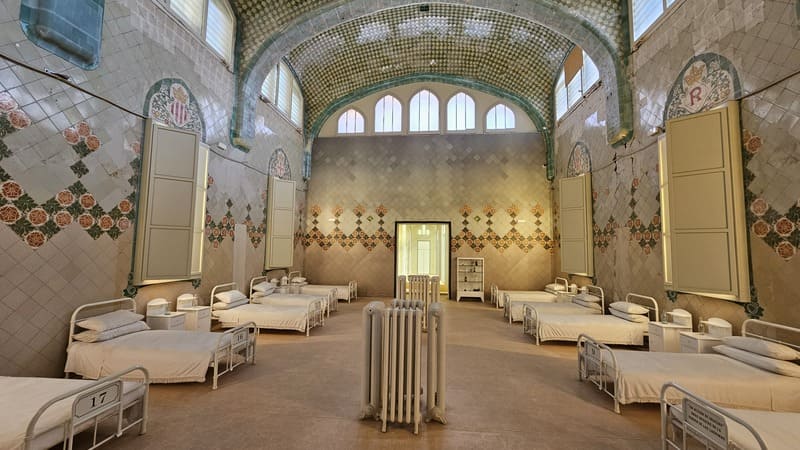
Each pavilion is genuinely different from the next, covered in mosaics, sculpture, and ceramic detail rather than repeated as identical blocks. The Sant Rafael pavilion, one of the more carefully restored spaces, still has its original patient ward layout, period radiators, Gothic-style windows, and floral ceramic tiles intact.
A building that outlived its own purpose
Sant Pau kept functioning as an actual, working hospital for over a century, treating patients right up until 2009, when operations finally moved to a modern facility nearby.
The historic site reopened to the public in 2014 under a new name, Recinte Modernista de Sant Pau, and today several of its pavilions house international organizations, including a WHO regional office in a building that used to be the obstetrics and gynecology ward.
In 1997, UNESCO listed the complex as a World Heritage Site, jointly with Palau de la Música Catalana, the same architect’s other masterpiece across the city.
Practical tips
Budget around an hour for a self-guided walk through the grounds, longer if you take a guided tour or want to sit in the gardens for a while.
Because it sits at the far end of Avinguda de Gaudí, this pairs naturally with a Sagrada Família visit, either right before or right after, without needing a separate trip across the city.
Where to go from here
Once you’ve walked Avinguda de Gaudí between the two, it’s worth knowing that Sant Pau’s architect built one more UNESCO-listed masterpiece across town, and it might be even more striking inside than this one. I wrote a full guide to it and a few of his other overlooked works: Barcelona’s best Modernisme buildings (and why they’re not all Gaudí).
And if you’re heading to Sagrada Família the same day, I’d read this one first. It changed how I look at that building entirely, and it pairs naturally with the reminder that Domènech i Montaner was building something just as ambitious right down the street: Is the Sagrada Família you saw in Barcelona really what Gaudí imagined?.