Casa Batlló: My Complete Guide
By Dorian · Updated August 20, 2026
Casa Batlló is the building most people photograph from the sidewalk and never actually walk into, which is a shame, because the inside is where it gets genuinely strange in the best way.
Here’s everything I’d want you to know before you go.
What Casa Batlló actually is
The building itself predates Gaudí by nearly 30 years, originally built in 1877 by Emili Sala Cortés, who happened to be one of Gaudí’s own architecture professors.
In 1903, textile industrialist Josep Batlló bought the property and wanted it torn down entirely, replaced with something bold enough to compete with the houses his neighbors were building.
Gaudí talked him out of demolition and proposed a full transformation instead. Between 1904 and 1906, he gutted the interior, expanded the central light well, redesigned the façade completely, and covered the roof in a curved, scaled shape that’s impossible to mistake for anything else in the city.
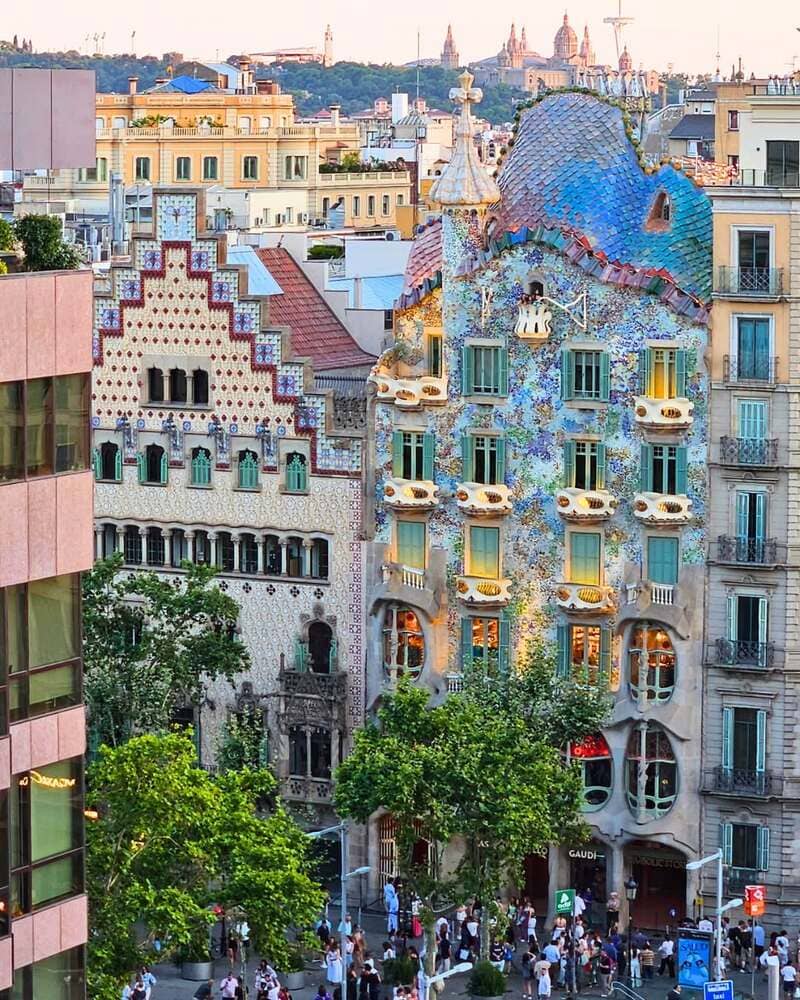
It’s part of the Illa de la Discòrdia, the “Block of Discord,” alongside Casa Amatller and Casa Lleó Morera, three architects competing for attention on the same block. Casa Batlló became a UNESCO World Heritage Site in 1984, with the listing extended in 2005 to formally include it among Gaudí’s collective body of work.
Getting there
It sits directly on Passeig de Gràcia, one of the easiest addresses in the city to find. Metro lines L2, L3, and L4 all stop within a short walk, and if you’re already exploring the Eixample or the Gothic Quarter, it’s an easy addition on foot.
Tickets
Casa Batlló runs a tiered ticket system, and it’s worth understanding the differences before you book.
The base ticket, Blue, includes the general visit, audio guide, and the Gaudí Cube, an immersive 360-degree digital room. Silver adds an augmented reality tablet, the restored Concierge Room, and the Gaudí Dôme experience. Gold builds further, adding access to the Batlló family’s private residence. Each tier costs more than the last, so it’s worth deciding how deep you want to go before choosing.
Children under 12 get in free. Booking online rather than at the door is consistently cheaper, and peak time slots do sell out days or weeks ahead in high season, so it’s worth reserving before you land. Check the official Casa Batlló website for current pricing, since it shifts by season and demand.
The façade and rooftop
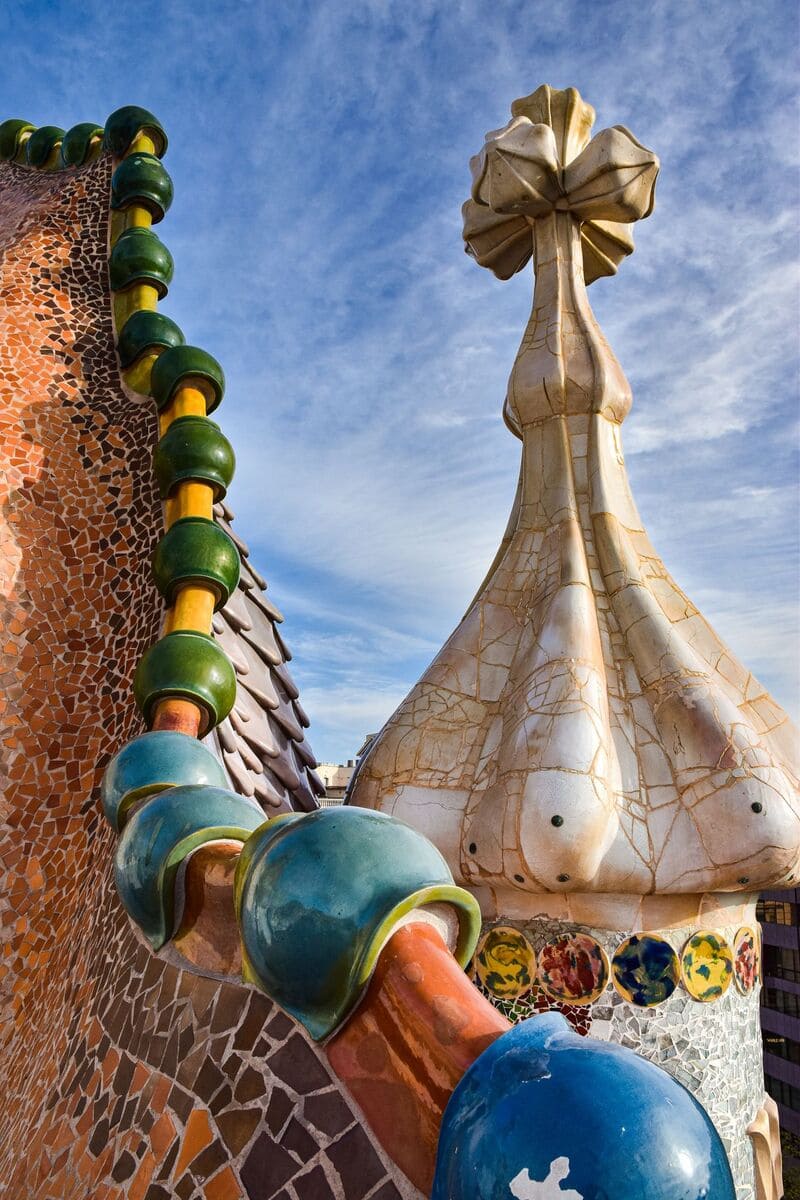
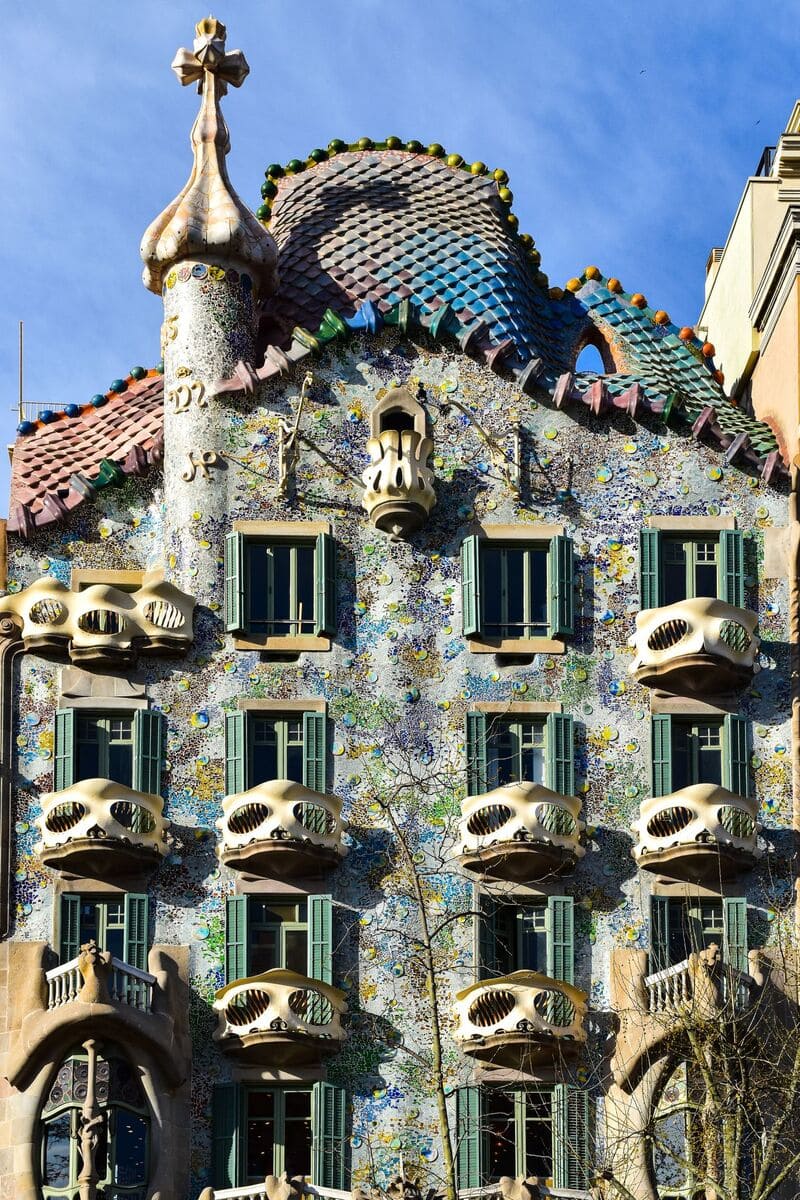
This is the part everyone recognizes before they know anything else about the building. The rooftop is widely read as a nod to the legend of Saint George slaying a dragon, patron saint of Catalonia, the curved, scaled tile roof representing the dragon’s back, and the small tower topped with a cross representing the saint’s spear driven through it.
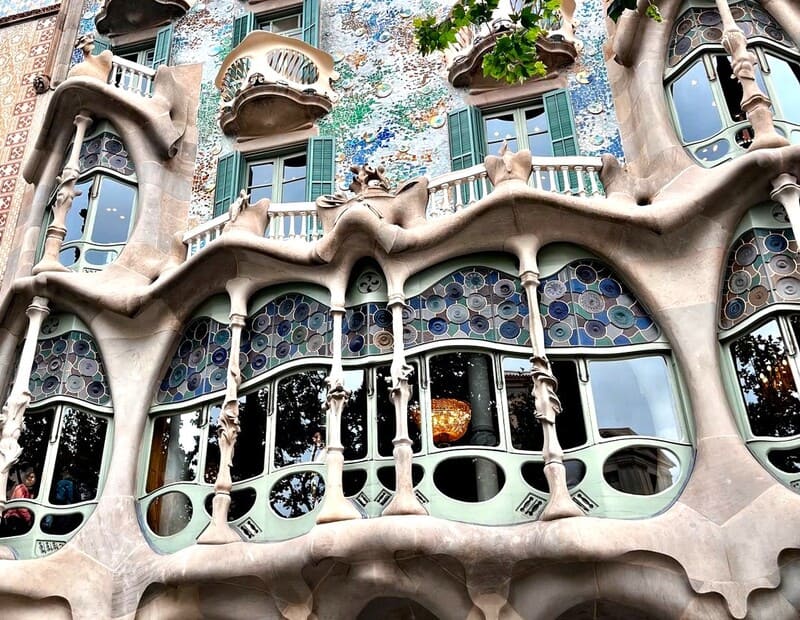
Below the roofline, the balconies are where the building earned its other nickname, the House of Bones. The stone railings curve and hollow out in a way that reads unmistakably skeletal, and the wavy, mask-like window frames have also given it the House of Masks and House of Yawns as informal names over the years. Gaudí was working from nature throughout, and it shows, nothing on this building sits at a right angle.
The Noble Floor
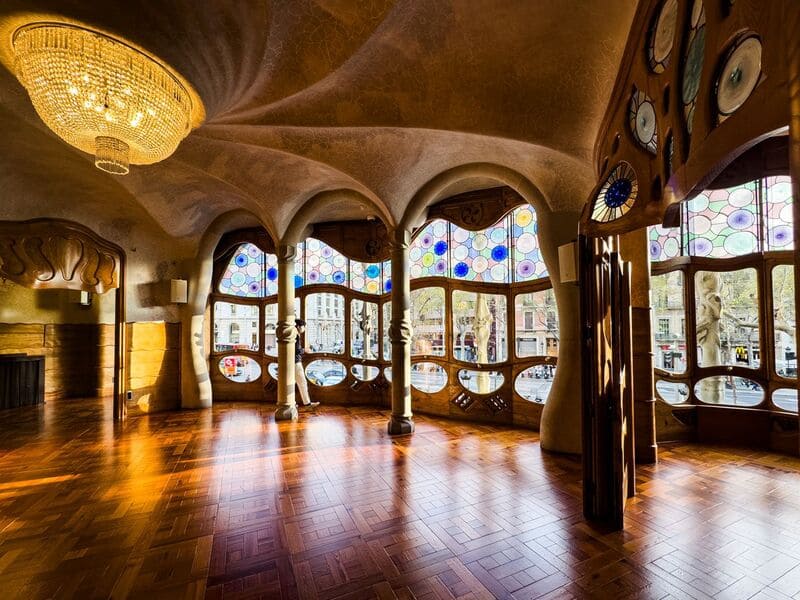
Inside, the visit starts on what was the Batlló family’s actual residence, the Noble Floor, and it’s the clearest evidence of how far Gaudí pushed the interior beyond a normal home.
The ceiling in the main salon spirals inward like a whirlpool, centered on a light fixture shaped like a sea anemone. Doors ripple like carved wood kelp. Look for the small mushroom-shaped fireplace nook tucked into the lobby, originally designed as an intimate corner for private conversation, easy to walk past if you’re not looking for it.
The light well
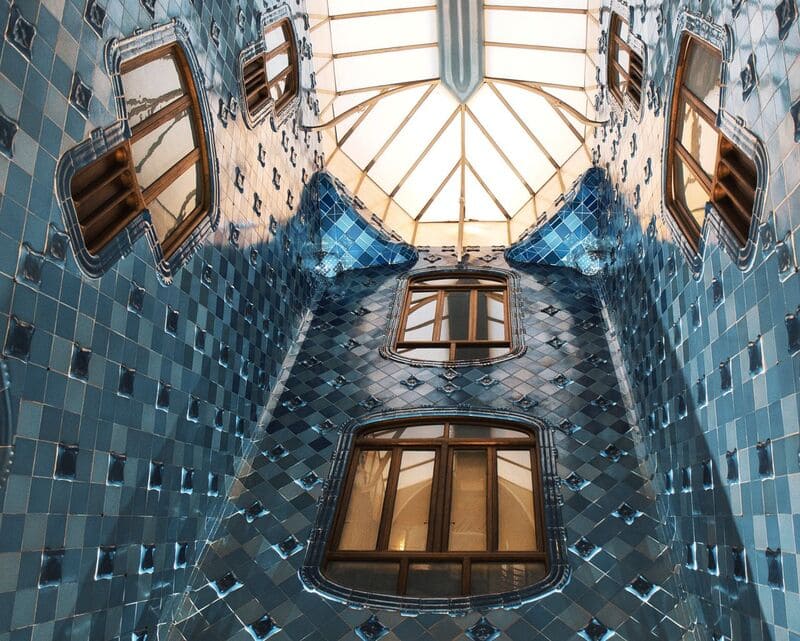
Stand in the central courtyard and look straight up. This shaft runs the full height of the building, tiled in blue that shifts gradually from deep cobalt at the top to pale sky blue near the bottom.
That gradient isn’t decorative alone, it’s functional. Gaudí designed it to even out the natural light reaching each floor, since upper floors get more direct sun than lower ones, larger windows lower down and darker tile higher up balance the difference out. It’s one of the clearest examples in the whole building of Gaudí solving an engineering problem and making it beautiful at the same time.
The attic
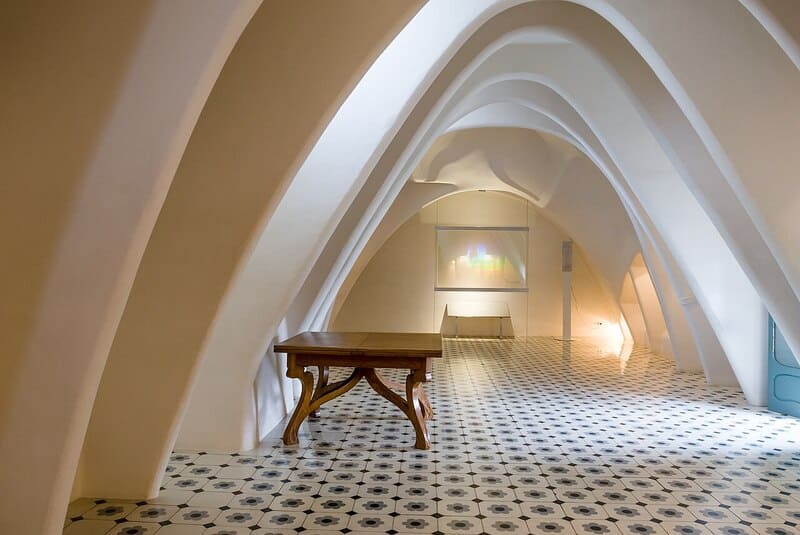
Climb higher and the building shifts again. The attic was originally a working service space, laundry and storage for the household, and it’s built from 60 white catenary arches lining the corridor, each one shaped like a rib.
Most visitors describe walking through it as walking inside the skeleton of the dragon whose back forms the roof above, whether or not that was Gaudí’s literal intention. It’s a genuinely different feeling from the ornate Noble Floor below, stripped down, structural, almost bodily.
The Gaudí Cube and immersive rooms
Casa Batlló leans harder into technology than most historic sites, and it works better than it sounds. The Gaudí Cube is a 360-degree immersive room, created with artist Refik Anadol, that surrounds you with projected shapes and color drawn from Gaudí’s own design language. Higher ticket tiers add the Gaudí Dôme, built around the natural forms, plants, shells, bone structures, that inspired his work in the first place.
It’s a good pairing with the historic rooms rather than a distraction from them, especially useful for connecting what you’ve just seen in the architecture to where the ideas actually came from.
Practical tips
Plan for 60 to 90 minutes inside, depending on how long you linger in the immersive rooms and how busy the narrower stairwells are on the day.
If crowds bother you, an early morning slot makes a real difference, the building narrows in places, and mid-afternoon can feel genuinely packed shoulder to shoulder. Casa Batlló is open daily nearly year-round, including most holidays, though it’s worth checking the official site for adjusted hours around major dates.
Where to go from here
Once you’re standing outside afterward, don’t just move on, look left and right. You’re standing in the middle of the Illa de la Discòrdia, and Casa Amatller and Casa Lleó Morera sit right beside you, each one designed by a different architect competing for the same attention Gaudí was chasing. I wrote about all three, plus several buildings you won’t find on the standard Gaudí trail, and it picks up exactly where this guide leaves off: Barcelona’s best Modernisme buildings (and why they’re not all Gaudí).
And if this was your first Gaudí building of the trip, I’d genuinely read this one before you go looking for the next. Park Güell tends to surprise people even more than Casa Batlló does, mostly because almost nobody knows it started life as a real estate project that completely failed: Park Güell: My complete guide.