Park Güell: My Complete Guide
By Dorian · Updated October 8, 2026
Park Güell gets sold to visitors as “a park,” which undersells it completely. It’s part failed real estate project, part open-air museum, part the closest thing you’ll find to walking directly into Gaudí’s imagination.
Here’s everything I’d want you to know before you go.
What Park Güell actually is
This wasn’t originally meant to be a park at all. Eusebi Güell, Gaudí’s most important patron, hired him in 1900 to design a private housing estate for Barcelona’s wealthy families, 60 plots on a hillside called Muntanya Pelada, inspired by the English garden city movement.
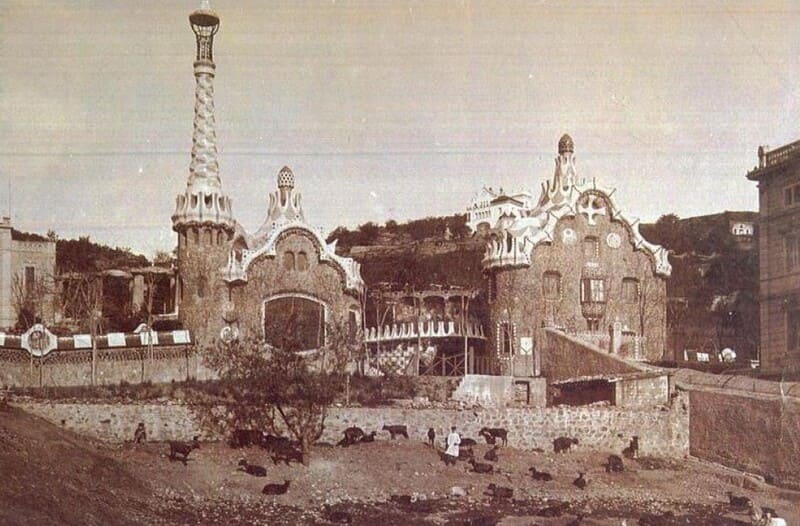
It flopped. Only two of the sixty planned houses were ever built, and neither was designed by Gaudí. Work stopped in 1914.
Güell himself lived in an older mansion that already stood on the land, Casa Larrard. It has been a school since 1931.
Gaudí moved into the model home built to attract buyers. He lived there from 1906 until 1925, nearly twenty years.
The estate later passed to the city, which turned it into a public park in the 1920s. UNESCO added it to the World Heritage List in 1984, as part of the Works of Antoni Gaudí.
Everything you see today, the mosaics, the columns, the terraces, was built for people who were never going to move in.
Getting there
Park Güell sits up in the Gràcia district, on a hillside, which means getting there always involves some uphill walking no matter which route you pick.
Here are your options, with the walking times the park itself gives.
- Metro line 3 to Lesseps: about a 20-minute walk. The park recommends the entrance on Avinguda del Santuari de Sant Josep de la Muntanya, which has an escalator.
- Metro line 3 to Vallcarca: also about 20 minutes on foot, using the escalator on Baixada de la Glòria. The park’s website has recently advised against this stop because those escalators were out of service, so check before you choose this route.
- Bus H6 or D40: get off at Travessera de Dalt, then walk about 10 minutes. You can enter from Avinguda del Santuari de Sant Josep de la Muntanya, where automatic stairs take out some of the climb, or from Carrer de Larrard.
- Bus Turístic (blue route) or Barcelona City Tour (east route, green): the stop is called Park Güell, on Avinguda de la Mare de Déu de Montserrat. It’s about a 10-minute walk, and the park suggests the entrance on Carretera del Carmel, reached through Avinguda Pompeu Fabra.
- Taxi: the park has one taxi stand, on Carretera del Carmel. That’s also the entrance the park recommends if hills are a problem for you.
- Private car: not recommended, because most parking around the park is reserved for residents. The park points visitors to the Travessera de Dalt – Park Güell car park.
- Tour coach: coaches use the parking platform off Carretera del Carmel, and the space has to be reserved through the Zona Bus website.
Works and closures can change which routes are easiest.
Tickets and timing
Here’s the part that trips people up: Park Güell is not a free park with a paid corner.
Since October 2013, entry to the main area has been regulated. The ticket covers about 30 acres (12 hectares). That includes the famous Gaudí works, and also the green areas and the viewpoints inside it.
Beyond that area, there’s an adjacent woodland of about 20 acres (8 hectares) that sits outside the regulated zone. Most of the well-known Gaudí works are inside the ticketed area, not there.
You choose from a few ticket types:
- Park visit: a self-guided visit of the whole ticketed area.
- Guided tour: groups of up to 25 people, in Catalan, Spanish, English or French.
- Park visit with the Gaudí House Museum: adds the house where Gaudí lived.
- Park visit with the Casa del Guarda: adds the exhibition inside the caretaker’s house at the entrance.
Young children enter free but still need a ticket. Visitors over 65 pay a reduced rate, and you’ll need proof of age when you buy. Prices change, so check the official Park Güell site for current rates.
Here’s how entry works:
- Tickets are for timed slots. You can book online up to three months ahead.
- Your ticket stays valid for entry up to 30 minutes after the start time printed on it. After that, you lose your right to enter.
- Once you’re inside, you can stay as long as you like. If you leave, you can’t come back in.
- Tickets are named and personal. The name must match your ID, and staff can ask to see it at the entrance.
- Slots are limited, so book ahead. The park asks visitors to buy only through its official site.
- The early-morning and evening hours are reserved for residents. Tourist visits aren’t allowed then, so don’t count on slipping in for free.
For the best light and the smallest crowds, aim for the first slot of the day, right at opening, or one of the last slots before closing.
The Porter’s Lodge pavilions
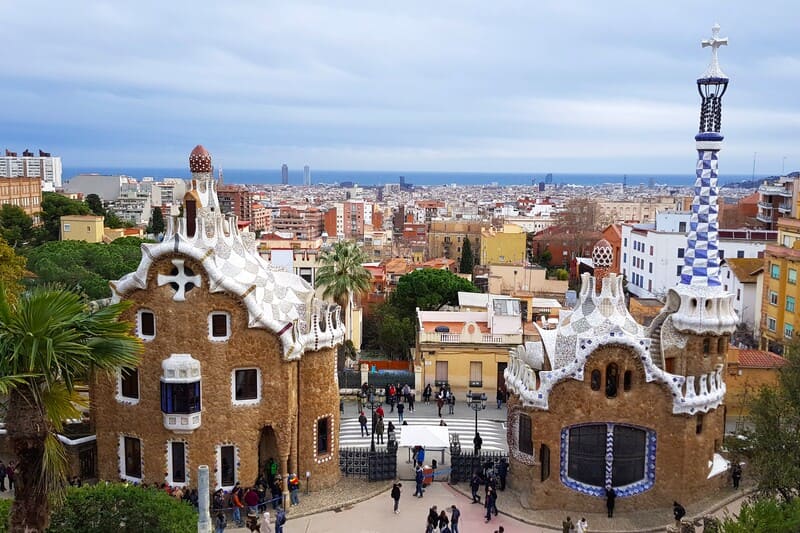
The two pavilions at the Carrer d’Olot entrance are the first thing you see. They deserve more than a photo on the way in.
Both have roofs built with traditional Catalan clay tiles, covered in trencadís, a mosaic made of tile shards.
One pavilion was the lodge itself, with a waiting room and a telephone booth. The other was the caretaker’s home, known as the Casa del Guarda.
Look up. One pavilion is crowned by a mushroom-shaped dome. The other has a tower topped with a four-armed cross, a symbol Gaudí used again in other buildings.
The Casa del Guarda was built between 1901 and 1903 as a modest home for a humble family. It’s now part of the Barcelona City History Museum.
Its exhibition covers the house, the park and the city, one subject per floor. You get in with the combined ticket.
A Gaudí and Barcelona bookshop run by Laie fills the other pavilion.
The iron gate between the two isn’t original to the park either. Its palm-leaf shapes came from Casa Vicens, Gaudí’s first major house.
The Dragon Staircase
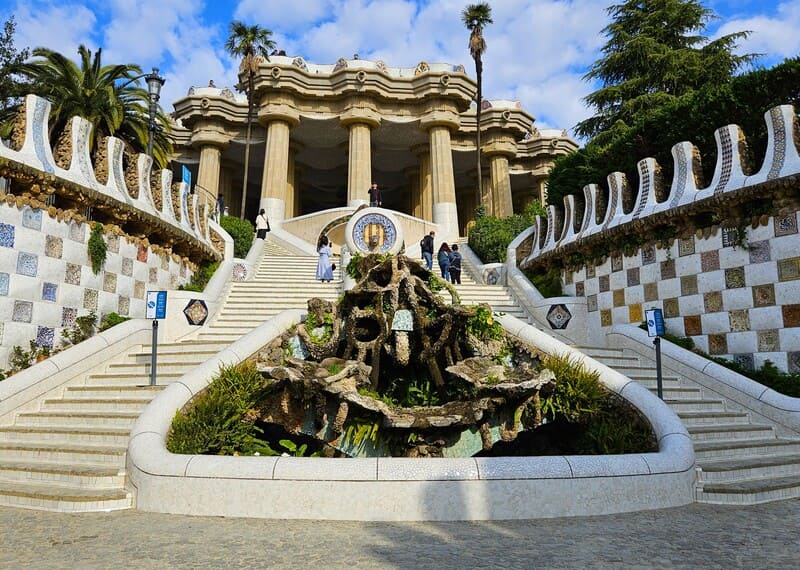
Just past the entrance, a grand double staircase climbs toward the Hypostyle Room. Partway up sits the most popular image of the whole park: a mosaic creature everyone calls El Drac, “the dragon,” even though it’s technically closer to a salamander.
It’s covered head to tail in trencadís, Gaudí’s signature technique of covering curved surfaces with broken ceramic fragments.
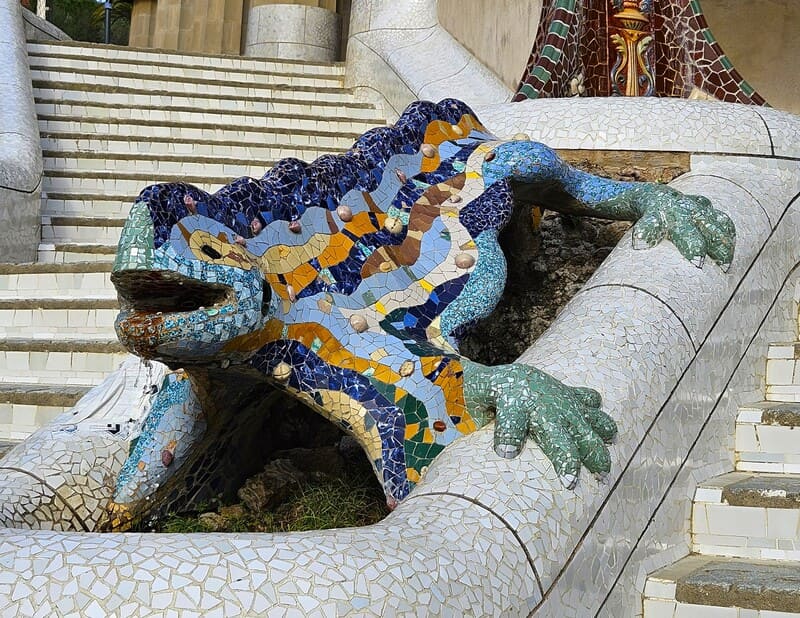
The dragon isn’t purely decorative either. Rainwater collects in an underground tank beneath the Hypostyle Room, and the dragon’s mouth is its overflow.
Expect a wait for a photo during busy hours. The Dragon Stairway sits behind a second checkpoint, where visitors follow a one-way route.
The Hypostyle Room
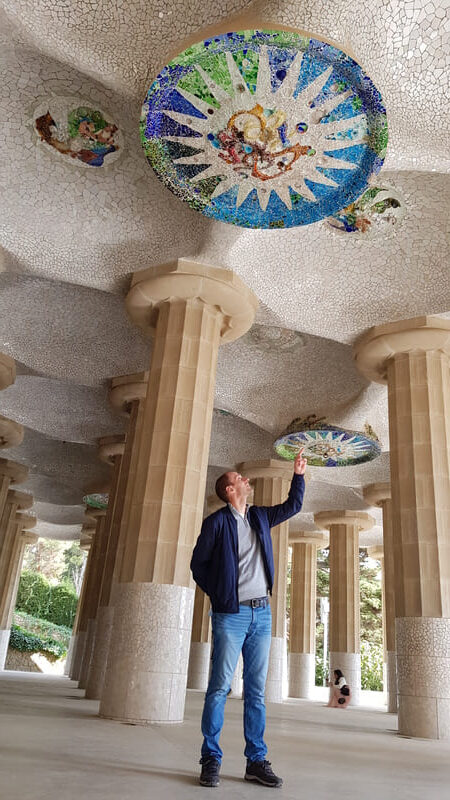
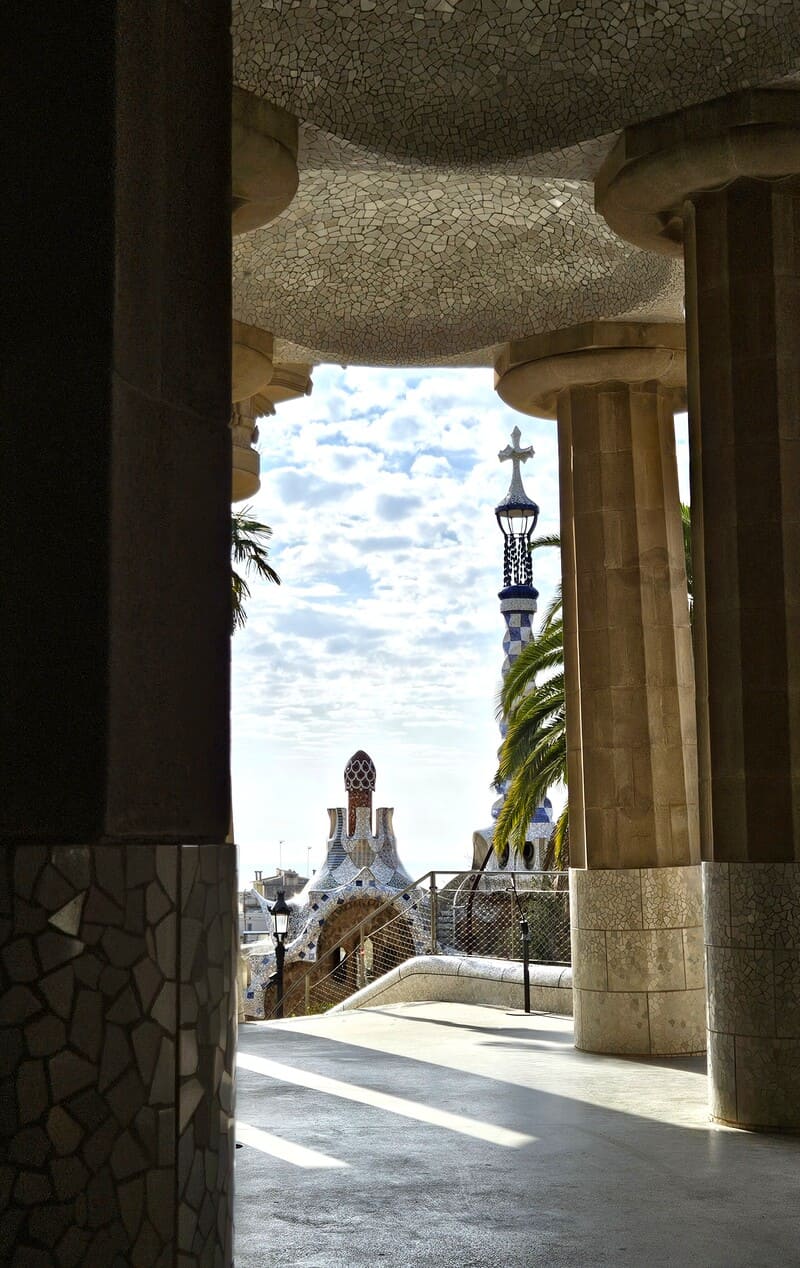
Above the staircase, you walk straight into a forest of 86 columns inspired by the Doric order of ancient Greece. The room was originally designed as the covered marketplace for the housing estate that never materialized.
Check the outermost columns. They lean in an undulating line, which breaks the rules of classical architecture and shows they are carrying the weight.
Look up. The ceiling is a series of small domes made with traditional clay bricks, decorated with tile-shard mosaics by Josep Maria Jujol, one of Gaudí’s assistants.
It’s easy to walk through quickly on the way to the terrace above, but this room rewards a slower pace and a few minutes spent just looking up.
The main terrace and the serpentine bench
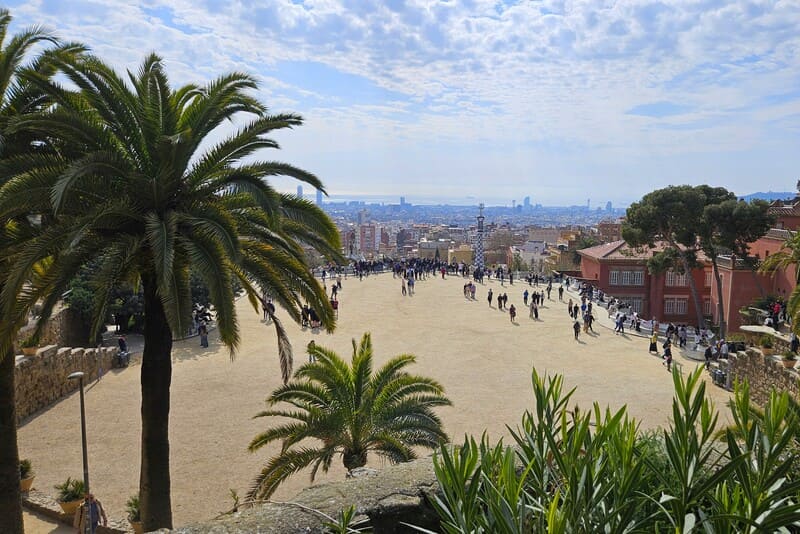
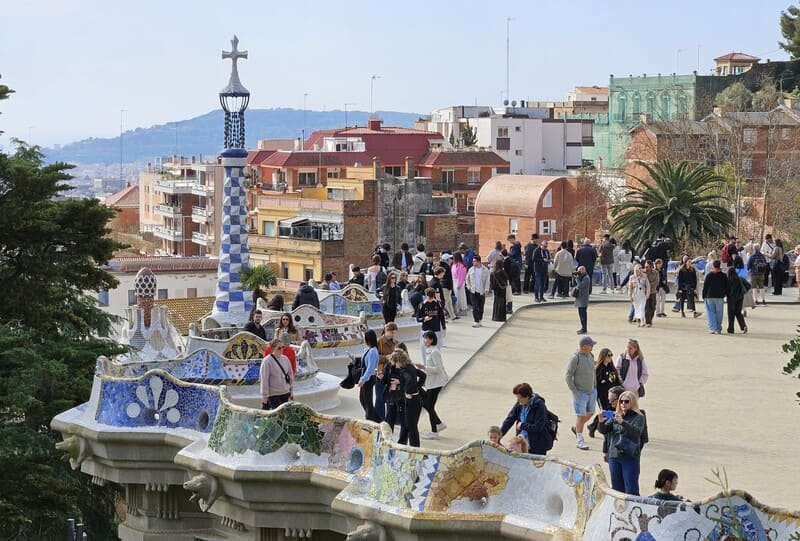
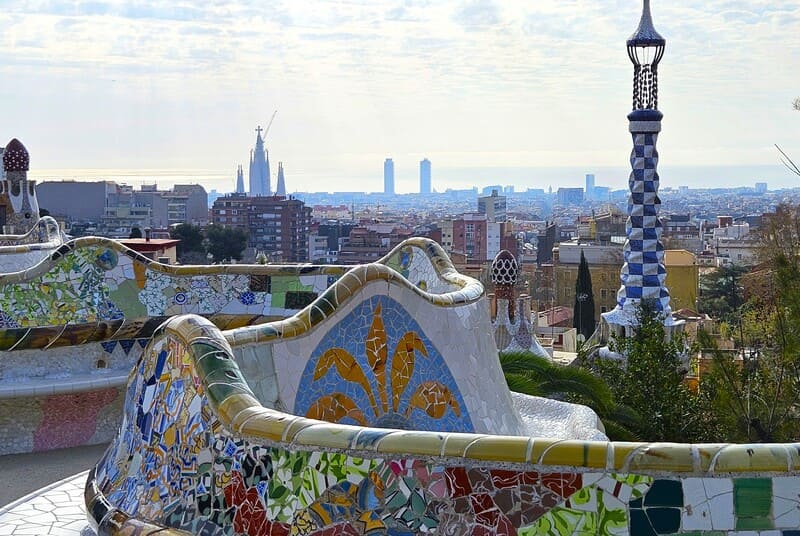
This is the view everyone pictures when they think of Park Güell: a long, undulating bench wrapping around the edge of a wide open terrace, entirely covered in colorful trencadís mosaic, with Barcelona and the sea spread out below.
On the original plans, this square was called the Greek Theatre. It was meant for open-air shows watched from the surrounding terraces. Today it’s also called Plaça de la Natura, or Nature Square.
The ground isn’t natural either. Part of the square is dug into the rock, and part of it sits on top of the Hypostyle Room you just walked through.
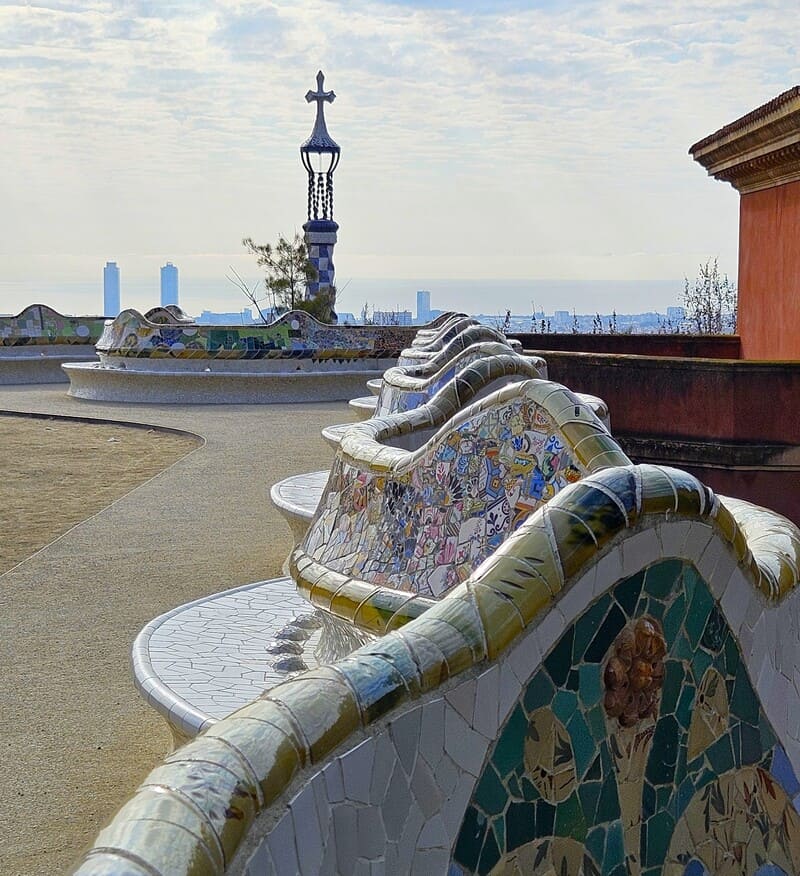
The bench stretches about 360 feet (110 meters). Josep Maria Jujol designed it, and it was built between 1909 and 1914.
On the staircase side, the bench also works as a balustrade. It’s a genuinely good place to just sit for a while.
The Laundry Room Portico
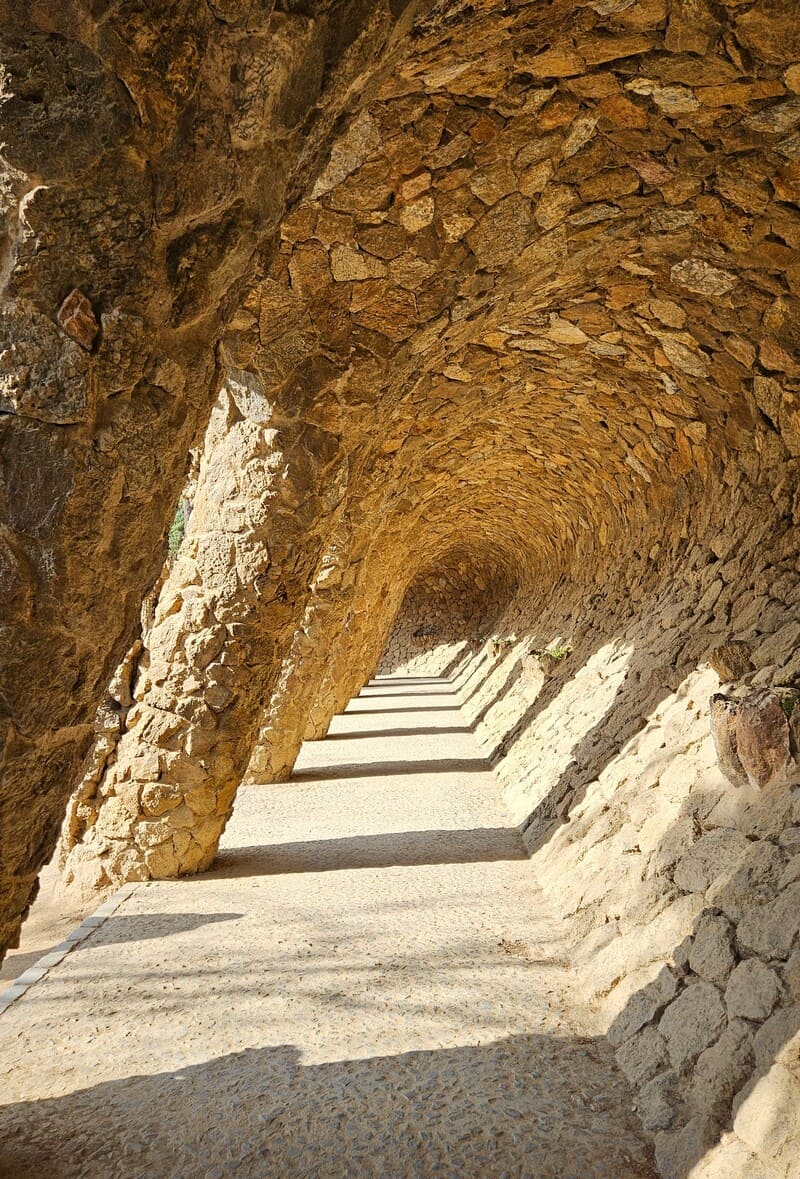
On the eastern side of the terrace, an original iron door opens onto a path through a pine grove.
At the end you reach the portico: a wave of unworked stone resting on slanting columns, with a double colonnade that acts as a buttress. It’s one of the best examples of the organic architecture Gaudí believed in.
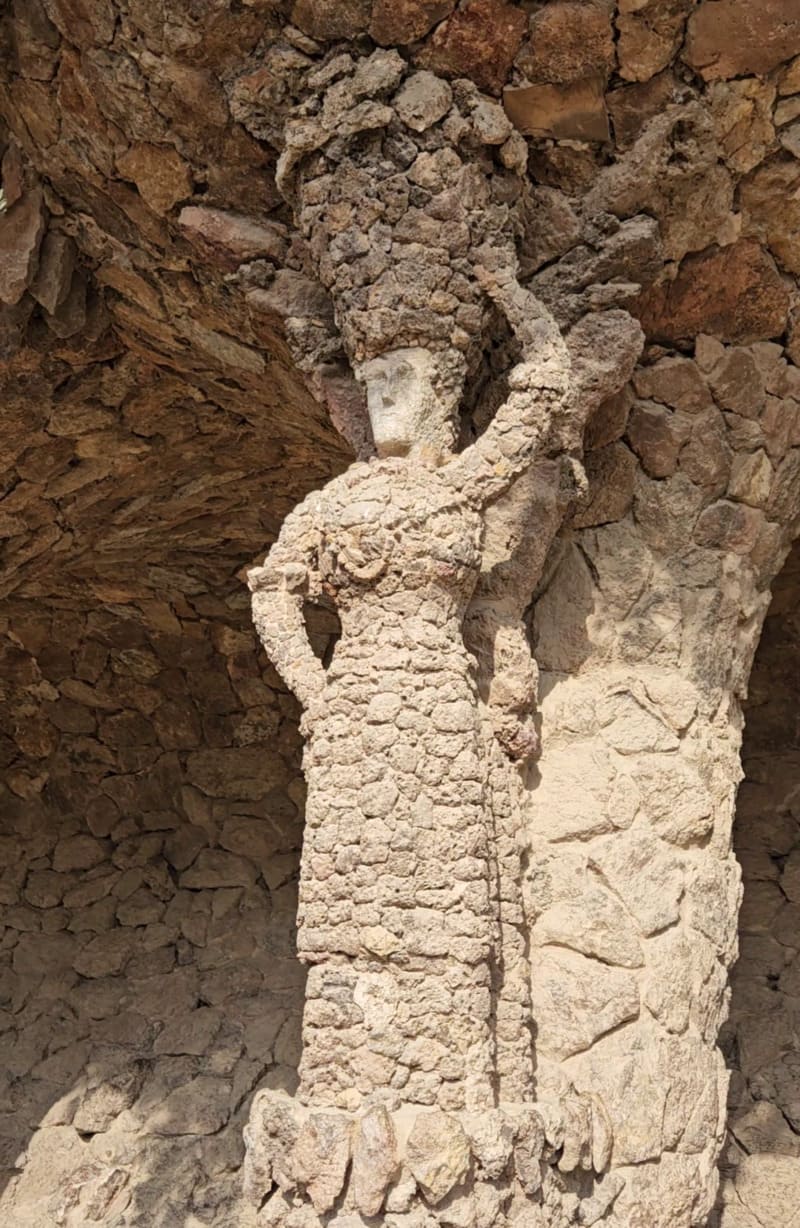
The name comes from one of the columns. It’s a caryatid (a sculpted figure used as a column) of a washerwoman carrying the tools of her trade.
Past the portico, a spiral ramp leads down toward the house at the end of the path.
This is another space behind the second checkpoint, so expect a wait when it’s busy.
The viaducts
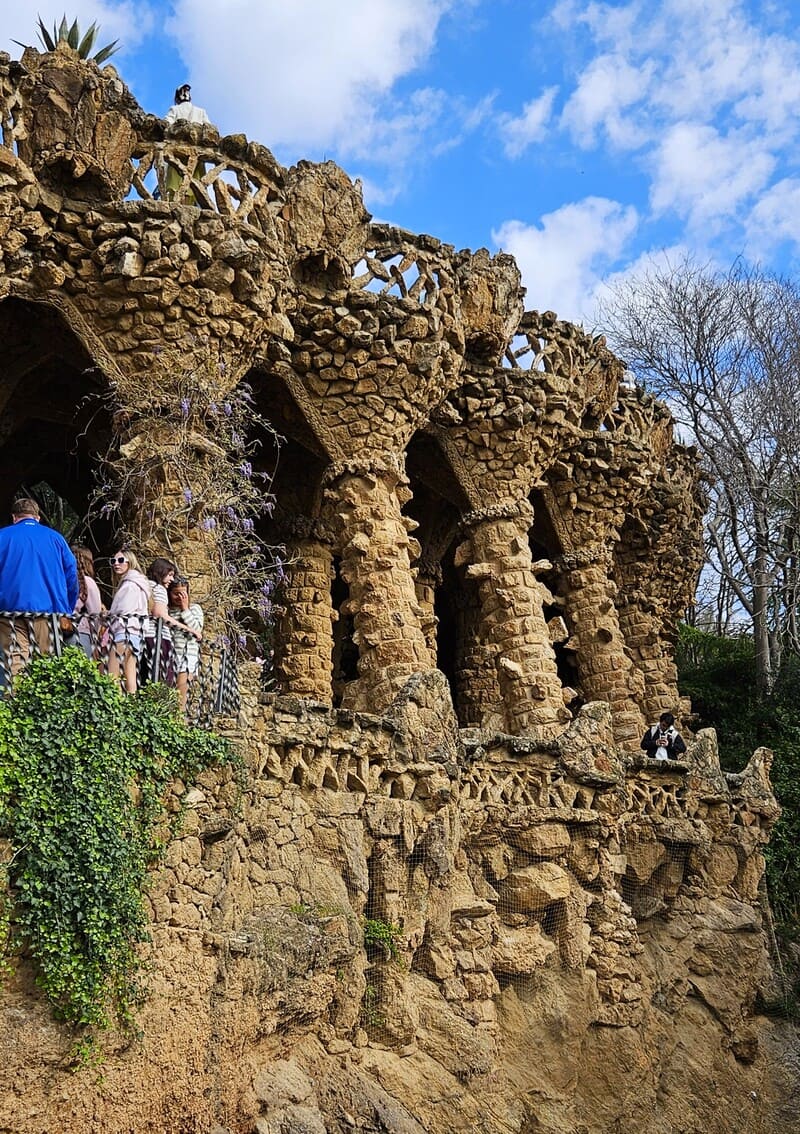
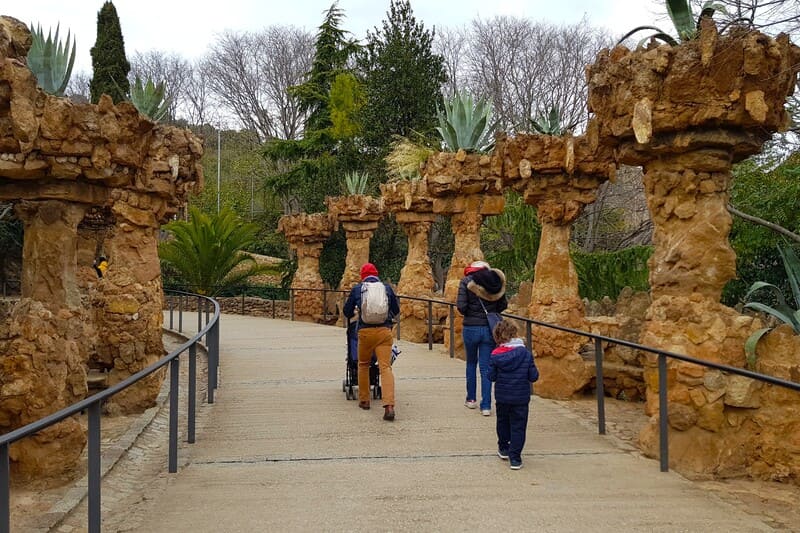
Gaudí planned three viaducts: the Low, Middle and High bridges (Pont de Baix, Pont del Mig and Pont de Dalt). Those names already appeared on the park’s first postcards.
Their job was practical. They are part of a road network of about 1.9 miles (3 kilometers) that Gaudí designed for the steep site. The viaducts were meant to lead carriages from the main entrance on Carrer d’Olot up to the Hill of the Three Crosses.
Each one is about 16 feet (5 meters) wide. They rest on sloping columns and vaults of rough stone taken from the site itself.
Those sloping columns came back later. Gaudí used the same idea in the crypt at Colònia Güell.
The Low Viaduct is the first one you meet, close to the central area on the way east toward the Carretera del Carmel exit. It curves, held up by two rows of sloping columns that form a parabola. Small columns along the edge hold plant pots that work as a railing.
The Middle Viaduct is known as the carob bridge. Its design respects the natural growth of a carob tree.
The viaducts also copy nature. Their shapes imitate caves, they hold back the mountain like buttresses, and the space underneath gives shelter in bad weather. The High Viaduct is called the bridge of the lovers.
Each one also had a cistern, with a system to capture and filter rainwater.
The Hill of the Three Crosses
The Hill of the Three Crosses (Turó de les Tres Creus) sits near the top of the park, at about 600 feet (182 meters) above sea level. It’s a great viewpoint over Barcelona.
The estate’s plans called for a chapel on this hill. When the housing project failed, the chapel was dropped. Three stone crosses were put up instead, to simulate Calvary.
The hill was once also known as Ore Hill and the Hill of Mines and Caves.
It’s an uphill walk, so save it for the end of your visit and only if you have the energy. Paths do close for works from time to time, so check the park’s official map and its disruptions page first.
Gaudí House Museum
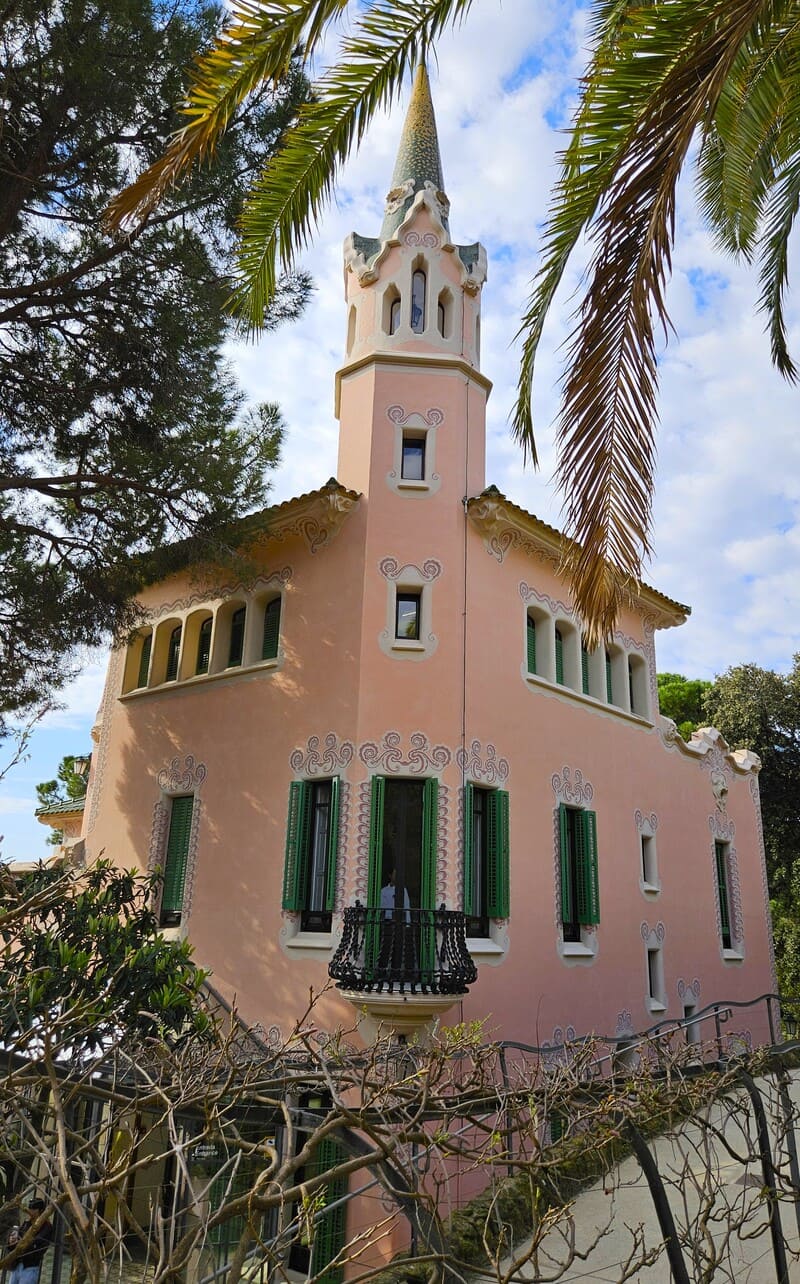
Inside the park stands the house where Gaudí lived from 1906 to 1925. It’s now a museum.
He didn’t design it. The house was built as a model home to attract buyers, to plans by his friend and collaborator Francesc Berenguer. Gaudí signed the plans because Berenguer wasn’t a qualified architect.
Inside, you’ll find original furniture Gaudí designed for Casa Calvet, Casa Batlló and the crypt at Colònia Güell. The garden shows wrought ironwork from Casa Vicens and Casa Milà.
You visit it with the combined ticket, bought together with your park entry. Check that the museum is open on your date before you choose that ticket. Worth adding if you want a more personal side of Gaudí.
A suggested route inside the park
The park puts the average visit at about one hour. If you want the viaducts and the Three Crosses, plan for more.
The Dragon Stairway, Hypostyle Room, Plaça de la Natura, Laundry Room Portico and Austria Gardens all sit behind a second checkpoint. Visitors follow a one-way route there, and waits are possible at busy times.
- Start at the Carrer d’Olot entrance and look at both pavilions. If you have the Casa del Guarda ticket, go in now.
- Climb the Dragon Staircase.
- Walk through the Hypostyle Room, and take a minute to look up.
- Go up to the terrace and sit on the serpentine bench. Public toilets are next to Plaça de la Natura, on Passeig de les Palmeres.
- Take the iron door on the eastern side of the square to the Laundry Room Portico.
- Follow the road network to the viaducts, starting with the Low Viaduct.
- If you have the energy, finish at the Hill of the Three Crosses.
Bring water. Fountains with drinking water are marked on the park’s map.
When you’re done, the park’s taxi stand is on Carretera del Carmel.
Where to go from here
If Park Güell left you wanting more Gaudí, you’re actually not far from where his story starts. Casa Vicens, his first major house, sits just down the hill in Gràcia, quieter and far less crowded than anything else with his name on it.
I wrote a full guide to the buildings that came before he devoted himself entirely to Sagrada Família, and it picks up right where this one leaves off: Barcelona’s best Modernisme buildings (and why they’re not all Gaudí).
And if you’re still deciding how to fit Park Güell into a wider trip without exhausting yourself, I’d genuinely read this one before you finalize your plans. It’s the itinerary I’d hand a friend, built specifically around not overpacking your days: The perfect 3-day itinerary in Barcelona.